








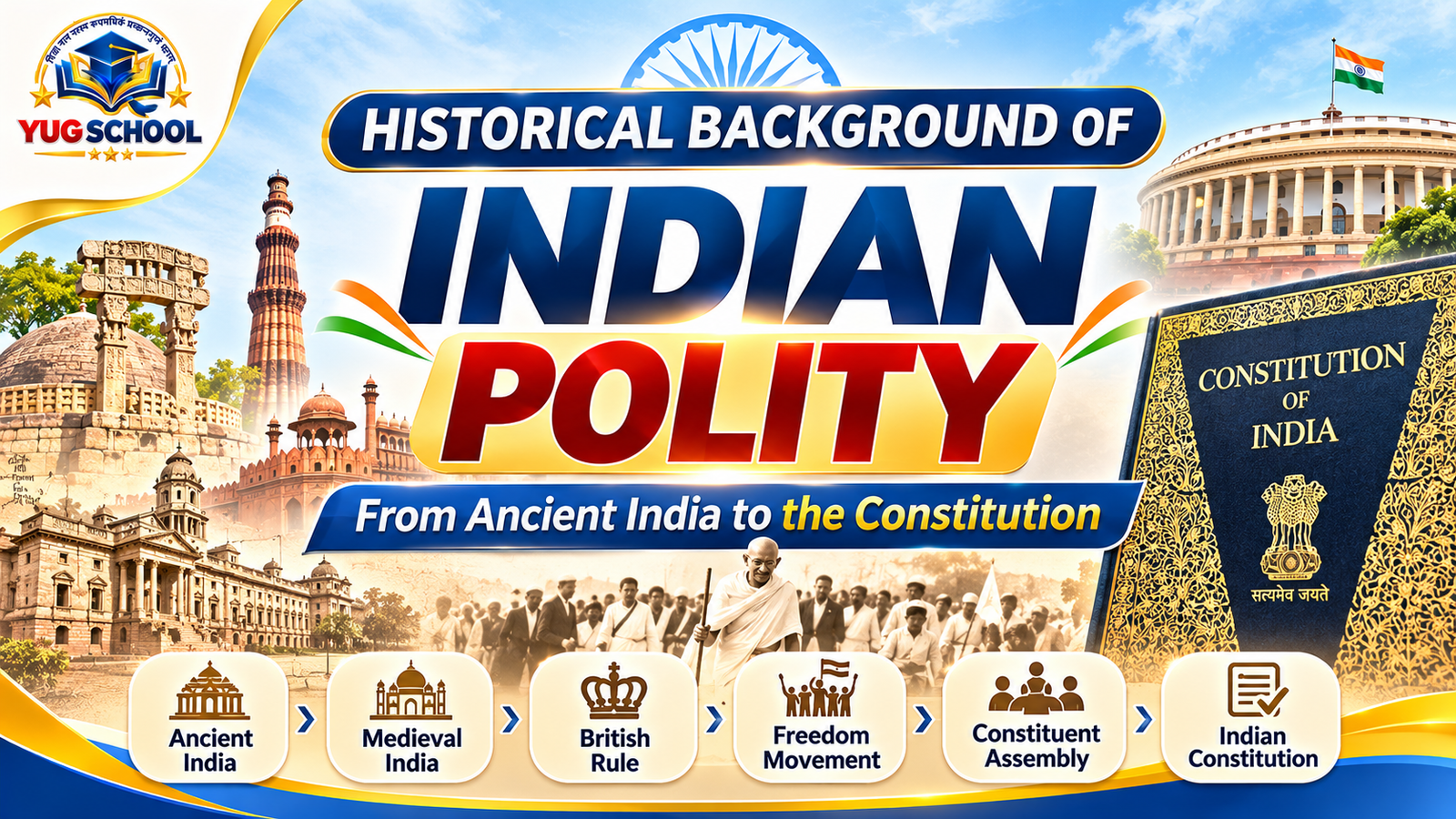
Historical Background of Indian Polity
Table of Contents
- Meaning and Scope of Indian Polity
- Political and Administrative Ideas in Ancient India
- Political and Administrative Developments during Medieval India
- Arrival of the Europeans and the Rise of British Political Power
- Constitutional Development under Company Rule (1773–1858)
- Crown Rule in India (1858–1947)
- Indian Councils Act, 1861
- Indian Councils Act, 1892
- Indian Councils Act, 1909: Morley–Minto Reforms
- Government of India Act, 1919: Montagu–Chelmsford Reforms
- Simon Commission, 1927
- Nehru Report, 1928
- Round Table Conferences, 1930–1932
- Communal Award, 1932 and Poona Pact
- Government of India Act, 1935
- Indian Independence Act, 1947
- The Constituent Assembly of India
- Sources and Influences of the Indian Constitution
- Important Features of the Indian Constitution at Its Commencement
- Major Constitutional Developments after 1950
- The Preamble and Its Historical Importance
- Important Constitutional Cases that Shaped Indian Polity
- Chronological Timeline of the Historical Background of Indian Polity
- Difference between Company Rule and Crown Rule
- Major Differences between the Government of India Acts of 1919 and 1935
- Contribution of the Freedom Movement to Indian Polity
- Historical Background of Indian Polity: Important Facts for Competitive Examinations
- Frequently Asked Questions on the Historical Background of Indian Polity
- Conclusion
Introduction
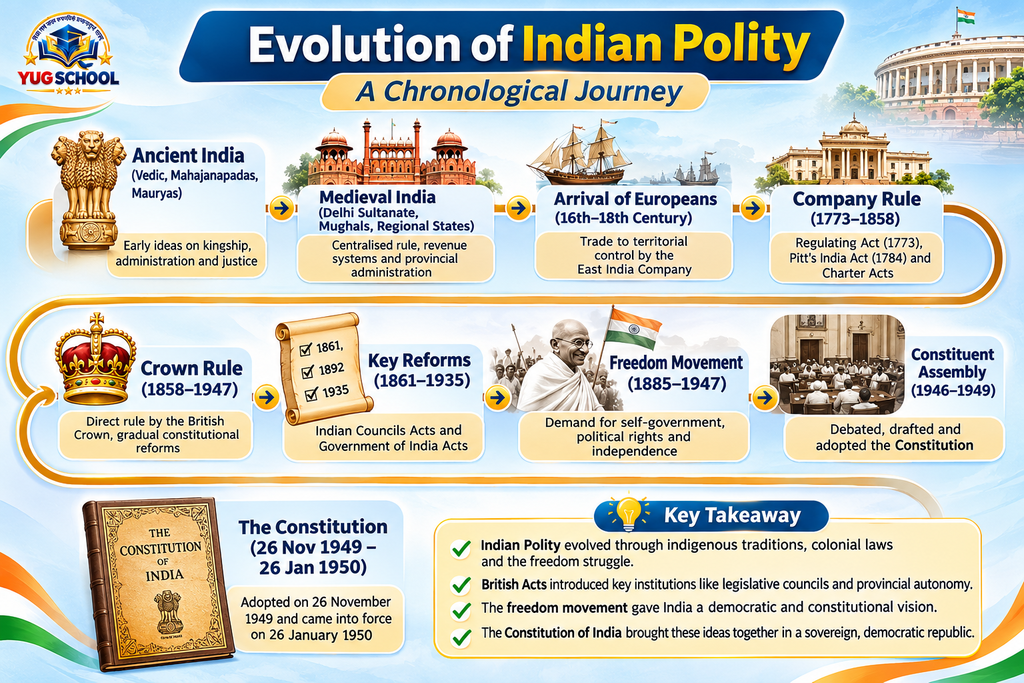
Indian Polity did not develop in a single period. It evolved through centuries of political thought, administrative experiments, social movements, colonial laws, and constitutional debates. The present political system reflects this long journey.
India follows a constitutional and parliamentary system of government. The Constitution defines the powers of the Union and State governments. It also protects citizens’ rights, establishes independent institutions, and sets limits on the exercise of public authority. However, these arrangements did not appear suddenly in 1950. Several historical developments shaped them.
Ancient Indian kingdoms developed ideas about kingship, justice, taxation, administration, and public welfare. Medieval rulers introduced different systems of central and provincial administration. Later, the British East India Company established political control over large parts of the country. The British Parliament gradually passed laws to regulate the Company’s administration and strengthen colonial authority.
Over time, these laws introduced important institutional changes. They created central legislative bodies, expanded legislative councils, introduced limited elections, and experimented with provincial autonomy. At the same time, Indian political leaders demanded representative government, civil liberties, and complete independence.
The freedom movement transformed these demands into a national constitutional vision. The Constituent Assembly converted that vision into a written Constitution. It adopted the Constitution on 26 November 1949. The Constitution came into force on 26 January 1950.
This article explains the historical background of Indian Polity in a chronological and easy-to-understand manner. It covers ancient political ideas, medieval administration, British constitutional developments, the freedom struggle, the Constituent Assembly, and major post-independence developments.
1. Meaning and Scope of Indian Polity
Indian Polity refers to the political and constitutional system of India. It explains how the country governs itself and how different institutions exercise public power.
The subject covers more than the Constitution alone. It includes the structure of government, the relationship between different levels of administration, the rights of citizens, and the responsibilities of public institutions.
1.1 What Does Indian Polity Include?
Indian Polity covers several connected areas.
Constitution: The Constitution is the supreme law of India. It establishes the framework of government and defines the powers of public institutions.
Legislature: The legislature makes laws. At the Union level, Parliament consists of the President, the Lok Sabha, and the Rajya Sabha.
Executive: The executive implements laws and runs the administration. It includes the President, Prime Minister, Council of Ministers, and administrative machinery.
Judiciary: The judiciary interprets laws and protects constitutional rights. The Supreme Court stands at the top of India’s judicial system.
Federal Structure: India has a Union government and State governments. The Constitution distributes legislative and administrative responsibilities between them.
Fundamental Rights: Part III of the Constitution guarantees important rights to individuals.
Directive Principles: Part IV lays down principles that guide the State while making laws and policies.
Local Government: Panchayats and municipalities provide institutions for local self-government.
Constitutional Bodies: The Election Commission, Union Public Service Commission, Comptroller and Auditor General, and other bodies perform specific constitutional functions.
These institutions form the foundation of India’s political system. Their historical development helps explain why the Constitution contains its present features.
1.2 Why Should We Study the Historical Background?
The historical background explains the reasons behind many constitutional provisions.
For example, British rule introduced centralised administration and several forms of legislative councils. The Government of India Act, 1919 introduced dyarchy in the provinces. Later, the Government of India Act, 1935 introduced provincial autonomy and provided for a three-fold distribution of legislative subjects.
The Constitution-makers studied these developments. They retained certain administrative arrangements but rejected colonial restrictions and discriminatory practices.
Therefore, historical knowledge helps students understand the purpose of constitutional provisions. It also makes topics such as federalism, parliamentary government, elections, and civil services easier to understand.
2. Political and Administrative Ideas in Ancient India
The history of Indian Polity begins long before British rule. Ancient Indian society developed several ideas about governance, justice, administration, and public welfare.
Different kingdoms followed different political arrangements. Their systems changed with time and varied across regions. Nevertheless, ancient Indian political thought provides important context for understanding the country’s administrative traditions.
2.1 The Indus Valley Civilisation
The Indus Valley Civilisation flourished during the Bronze Age. Its major urban centres included Harappa and Mohenjo-daro.
Archaeological discoveries reveal organised urban planning, drainage systems, public structures, and standardised weights and measures. These features suggest a high level of civic organisation.
However, historians have not established the exact political structure of the civilisation. The available archaeological evidence does not provide a confirmed account of its rulers, legislative institutions, or administrative hierarchy.
Therefore, it would be inaccurate to describe the Indus Valley Civilisation as having a specific form of monarchy or republic. Its urban organisation remains an important part of India’s early administrative history, but its political system is not fully known.
2.2 Political Organisation during the Vedic Period
The Vedic period provides clearer references to political institutions and leadership.
The king, commonly called the Rajan, held an important position in many Vedic communities. However, his authority did not always operate without consultation.
Two institutions often discussed in Vedic literature are the Sabha and the Samiti.
- Sabha: A smaller assembly associated with discussion and consultation.
- Samiti: A broader assembly associated with collective deliberation and important public matters.
The precise functions of these institutions changed over time. Scholars also debate their membership and decision-making powers.
The king had responsibilities related to protection, justice, and the maintenance of order. Religious traditions and social customs also influenced political authority.
These arrangements show that consultation and collective deliberation existed in some ancient Indian political communities.
2.3 Mahajanapadas and the Rise of Territorial States
By around the sixth century BCE, northern India contained several large political units known as the Mahajanapadas.
Buddhist and Jain texts refer to sixteen Mahajanapadas. These included Magadha, Kosala, Vatsa, Avanti, Vajji, and others.
The Mahajanapadas represented an important stage in the development of territorial states. Their political systems were not identical.
Many followed monarchical forms of government. Others, particularly certain groups in the Vajji confederacy, followed oligarchic or republican arrangements.
These republican communities used assemblies and collective decision-making practices. However, they were not modern democracies. Political participation remained limited to specific groups.
The rise of the Mahajanapadas strengthened territorial administration, taxation, military organisation, and urban centres. It also prepared the ground for the emergence of larger empires.
2.4 The Mauryan Empire and Centralised Administration
The Mauryan Empire marked a major development in ancient Indian political history.
Chandragupta Maurya established the empire in the late fourth century BCE. His successors expanded and consolidated Mauryan authority across large parts of the Indian subcontinent.
The Mauryan administration combined central authority with provincial and local arrangements.
The king stood at the centre of the political system. Ministers, officials, provincial administrators, and local functionaries helped manage the empire.
Kautilya’s Arthashastra provides an important account of ancient Indian political and administrative thought. It discusses kingship, diplomacy, taxation, law, military organisation, espionage, and economic management.
However, historians should not treat every prescription in the Arthashastra as a direct description of the actual Mauryan administration. It is a text on statecraft, and its relationship with particular historical practices requires careful interpretation.
2.5 Kautilya’s Ideas on Statecraft
Kautilya, also known as Chanakya or Vishnugupta, is traditionally associated with the Arthashastra.
His political thought placed considerable emphasis on the stability and strength of the State. He discussed the responsibilities of the ruler and the administrative machinery required to govern a kingdom.
One important concept is the Saptanga Theory of the State. It identifies seven elements:
- Swami: The ruler.
- Amatya: Ministers and officials.
- Janapada: Territory and population.
- Durga: Fortified capital or defensive infrastructure.
- Kosha: Treasury.
- Danda or Bala: Armed force and coercive authority.
- Mitra: Allies.
The theory presents the State as a combination of connected elements. A strong ruler alone cannot ensure stability. The State also needs capable officials, a productive territory, financial resources, security, and reliable allies.
Kautilya also discussed the importance of public welfare. He recognised that the prosperity of the kingdom depended on the condition of its people.
These ideas remain useful for understanding the historical development of administration and political thought in India.
2.6 Ashoka and the Idea of Dhamma
Ashoka ruled the Mauryan Empire during the third century BCE. The Kalinga War had a major influence on his public policies.
After the war, Ashoka promoted Dhamma through his inscriptions. His messages emphasised moral conduct, respect for different religious communities, compassion, and concern for public welfare.
Ashoka appointed officials known as Dhamma Mahamatras to promote Dhamma-related activities. His inscriptions also refer to measures concerning medical treatment, roads, wells, and the welfare of people and animals.
Ashoka’s Dhamma should not be confused with a modern constitutional code. It was an ethical and administrative policy rather than a written constitution.
Nevertheless, his reign provides an important example of a ruler using public authority to promote moral responsibilities and social welfare.
2.7 Local Administration in Ancient India
Ancient Indian administration did not operate only from royal capitals.
Village-level institutions played an important role in many regions. Local communities managed matters such as land, irrigation, agriculture, and social affairs.
The structure and powers of these institutions varied across periods and regions. Some later South Indian inscriptions, particularly those associated with the Chola period, provide detailed evidence of village assemblies and local administrative arrangements.
These historical institutions were not identical to modern Panchayati Raj bodies. However, they demonstrate the long history of local collective organisation in India.
3. Political and Administrative Developments during Medieval India
Medieval Indian rulers introduced several administrative arrangements. Their systems reflected the political needs, geographical conditions, military requirements, and economic structures of their periods.
The Delhi Sultanate and the Mughal Empire developed extensive central and provincial administrations. Regional kingdoms also maintained their own political institutions.
3.1 Administration under the Delhi Sultanate
The Delhi Sultanate emerged in the early thirteenth century. It consisted of several dynasties, including the Mamluk, Khalji, Tughlaq, Sayyid, and Lodi dynasties.
The Sultan held the highest political authority. Ministers and officials managed important departments.
The central administration included offices responsible for finance, military affairs, correspondence, and religious endowments. The exact structure changed under different rulers.
The Sultanate divided its territories into administrative units. Governors and other officials supervised provincial and local administration.
The iqta system played an important role in revenue and military administration. Under this system, the State assigned revenue rights from particular territories to officials or military commanders in return for administrative and military responsibilities.
The system changed over time. It should not be understood as a uniform landownership arrangement.
3.2 Administrative Reforms of Alauddin Khalji
Alauddin Khalji introduced several administrative and economic measures.
He strengthened the central military system and introduced measures to maintain a large standing army. His administration also regulated market prices for important commodities.
Officials monitored markets and acted against violations of price regulations. These policies aimed to support the maintenance of the army and strengthen the Sultan’s control.
Alauddin’s measures show how medieval rulers used revenue administration, market regulation, and military organisation to consolidate political authority.
3.3 Administrative Reforms of Muhammad bin Tughlaq
Muhammad bin Tughlaq attempted several administrative and economic experiments.
His major initiatives included the transfer of the capital from Delhi to Daulatabad, token currency, and changes in taxation in the Doab region.
Some initiatives faced serious practical difficulties. The token currency experiment, for example, suffered from problems of control and counterfeiting.
These policies reveal the challenges of administering a large and diverse territory. They also show that administrative decisions require suitable institutions, resources, and effective implementation.
3.4 Sher Shah Suri and Revenue Administration
Sher Shah Suri ruled northern India between 1540 and 1545. Although his reign was relatively short, his administrative measures influenced later practices.
He improved roads and communication networks. The Grand Trunk Road received attention during his rule, although the route itself existed in earlier forms.
Sher Shah also introduced revenue measures based on land measurement and assessment. His administration used written records and sought greater regularity in revenue collection.
The Mughal administration later developed several of these practices further.
3.5 Mughal Central Administration
The Mughal Empire developed an extensive administrative structure.
The emperor held supreme political authority. Several high-ranking officials assisted in administration.
Important offices included:
- Wazir or Diwan: Associated with finance and revenue administration.
- Mir Bakshi: Responsible for military appointments and related matters.
- Sadr-us-Sudur: Associated with religious grants and certain judicial matters.
- Khan-i-Saman: Managed aspects of the imperial household and stores.
The exact responsibilities of these offices changed across reigns.
The Mughal Empire also used a provincial administrative structure. Provinces, known as Subahs, were administered by officials appointed by the emperor.
3.6 The Mansabdari System
Akbar developed and expanded the Mansabdari system as an important part of Mughal administration.
A mansab indicated an official’s rank and position. Mansabdars performed civil and military responsibilities.
The system helped the emperor organise officials and military resources. It also connected administrative service with rank and imperial authority.
The Mansabdari system should not be confused with a modern civil service. Its organisation reflected the political and military needs of the Mughal Empire.
3.7 Akbar’s Approach to Governance
Akbar introduced several measures to strengthen imperial administration.
He reorganised revenue administration and promoted a more systematic system of assessment. Raja Todar Mal is closely associated with the development of Mughal revenue arrangements.
Akbar also followed policies aimed at political integration. His approach to religious communities and regional elites helped consolidate Mughal authority.
His reign illustrates the importance of administrative coordination, revenue management, and political accommodation in a diverse empire.
3.8 Local Administration and Regional Kingdoms
Local administration continued to play an important role throughout medieval India.
Village communities, local chiefs, revenue officials, and regional authorities managed different aspects of public life.
The powers and responsibilities of these institutions varied considerably. Some regions maintained strong local traditions, while others experienced greater central control.
Therefore, medieval India did not follow one uniform administrative system. Its political history consisted of several overlapping systems and regional arrangements.
4. Arrival of the Europeans and the Rise of British Political Power
European trading companies arrived in India for commercial purposes. Over time, the English East India Company transformed itself from a trading organisation into a major political power.
This transition laid the foundation for British constitutional developments in India.
4.1 Establishment of the East India Company
Queen Elizabeth I granted a royal charter to the English East India Company on 31 December 1600.
The charter gave the Company trading privileges in regions east of the Cape of Good Hope. It marked the beginning of the Company’s organised commercial activity in Asia.
The Company initially focused on trade. It established factories and trading centres in different parts of India.
However, European competition and political changes within India gradually increased its involvement in local affairs.
4.2 Battle of Plassey, 1757
The Battle of Plassey took place on 23 June 1757.
The English East India Company, led by Robert Clive, defeated the forces of Siraj-ud-Daulah, the Nawab of Bengal. The role of Mir Jafar and other internal political factors contributed to the Company’s victory.
The battle gave the Company significant political influence in Bengal. It marked a major turning point in the expansion of British power.
4.3 Battle of Buxar, 1764
The Battle of Buxar took place on 22 October 1764.
The Company defeated the combined forces of Mir Qasim, the Nawab of Awadh Shuja-ud-Daulah, and the Mughal emperor Shah Alam II.
The victory strengthened the Company’s position in eastern India.
4.4 Grant of Diwani Rights, 1765
In 1765, Mughal emperor Shah Alam II granted the East India Company the Diwani rights of Bengal, Bihar, and Orissa.
Diwani rights gave the Company the authority to collect revenue and manage civil financial affairs in these territories.
This arrangement marked a major shift in the Company’s role. It now exercised important governmental powers in addition to its commercial activities.
However, the Company’s administration created serious problems. Revenue collection, public welfare, and political accountability remained weak.
The Bengal famine of 1770 exposed the severe human consequences of the region’s economic and administrative crisis.
The British Parliament eventually began taking a more direct interest in the Company’s affairs.
5. Constitutional Development under Company Rule (1773–1858)
The period from 1773 to 1858 witnessed the gradual regulation and centralisation of British administration in India.
The British Parliament passed several laws to control the East India Company. These laws also created institutions that later influenced India’s constitutional development.
5.1 Regulating Act, 1773
The Regulating Act of 1773 marked the first major attempt by the British Parliament to regulate the Company’s administration in India.
The Act followed concerns about corruption, financial difficulties, and administrative mismanagement.
Its major provisions included:
Governor-General of Bengal: The Act replaced the Governor of Bengal with the Governor-General of Bengal. Warren Hastings became the first Governor-General of Bengal.
Executive Council: A council of four members assisted the Governor-General. The Governor-General generally had to work with the council, although he had a casting vote in case of a tie.
Presidency Control: The Act sought to strengthen Bengal’s authority over the presidencies of Bombay and Madras in matters of war and peace, subject to specified conditions.
Supreme Court: The Act provided for the establishment of a Supreme Court at Fort William in Calcutta. The Court began functioning in 1774.
Company Regulation: The Act required Company officials to disclose certain financial interests and restricted private trade and the acceptance of gifts.
The Regulating Act was an important step towards parliamentary control over the Company’s administration. However, it did not create a fully defined constitutional system.
5.2 Act of Settlement, 1781
The Act of Settlement, also known as the Amending Act of 1781, modified certain provisions of the Regulating Act.
The Supreme Court’s jurisdiction had created disputes with the executive administration and raised questions about its authority over different categories of people.
The 1781 Act clarified aspects of the Court’s jurisdiction. It limited interference with revenue administration and provided exemptions for certain official acts performed by the Governor-General and Council.
The Act also clarified the position of personal laws in certain legal matters.
Consequently, it helped reduce some of the conflicts created by the earlier arrangement.
5.3 Pitt’s India Act, 1784
Pitt’s India Act of 1784 introduced a system of dual control over the Company’s political affairs.
The Act established a Board of Control in Britain. The Board supervised the Company’s political, civil, and military affairs.
The Court of Directors continued to manage the Company’s commercial activities and certain administrative matters.
This arrangement divided authority between the Company and the British government.
The Act also distinguished more clearly between the Company’s commercial functions and its political responsibilities.
Pitt’s India Act strengthened British governmental control over India. It also established an important model of dual supervision that continued in modified forms until 1858.
5.4 Charter Act, 1793
The Charter Act of 1793 renewed the Company’s charter for another twenty years.
It continued the Company’s commercial privileges and maintained the existing administrative structure.
The Act also strengthened the Governor-General’s authority over the subordinate presidencies in specified matters.
Although it did not introduce a major representative institution, it continued the gradual consolidation of central administrative authority.
5.5 Charter Act, 1813
The Charter Act of 1813 renewed the Company’s charter but ended its monopoly over most trade with India.
However, the Company retained its monopoly over trade with China and the tea trade.
The Act also permitted Christian missionaries to operate in India under specified conditions.
Another important provision concerned education. The Act provided for an annual sum of one lakh rupees for the revival and improvement of literature and the encouragement of learned Indians and the introduction and promotion of scientific knowledge.
The Act therefore affected trade, education, and missionary activity.
It also reflected the growing role of the British Parliament in shaping Indian policy.
5.6 Charter Act, 1833
The Charter Act of 1833 introduced major changes in the central administration of British India.
It redesignated the Governor-General of Bengal as the Governor-General of India. Lord William Bentinck became the first Governor-General of India.
The Act centralised legislative authority. It removed the legislative powers of the Bombay and Madras presidencies and placed lawmaking authority in the Governor-General-in-Council.
The Act also ended the Company’s remaining commercial activities. The Company became an administrative body rather than a trading organisation.
It provided for the appointment of a Law Member to the Governor-General’s Council. Thomas Babington Macaulay became the first Law Member.
The Act also declared that no person should be disqualified from holding office under the Company on the basis of religion, place of birth, descent, or colour. However, this principle did not produce equal access to administration in practice.
The Charter Act of 1833 became an important milestone in the development of central legislative authority in India.
5.7 Charter Act, 1853
The Charter Act of 1853 was the final Charter Act passed for the East India Company.
It introduced several important administrative changes.
Separation of Legislative and Executive Functions: The Act distinguished the legislative and executive functions of the Governor-General’s Council. It expanded the legislative council by adding members for legislative work.
Open Competition: The Act opened the way for competitive recruitment to the civil services. The first competitive examination for the Indian Civil Service took place in 1855.
No Fixed Renewal Period: Unlike earlier Charter Acts, it did not renew the Company’s charter for another fixed period of twenty years.
Legislative Participation: The enlarged legislative council included additional members who participated in lawmaking.
The Act represented a gradual movement towards a more specialised legislative structure and a merit-based civil service.
However, British control remained dominant. Indians had very limited opportunities to participate in higher administration.
6. Crown Rule in India (1858–1947)
The Revolt of 1857 exposed the weaknesses of Company administration. It also forced the British government to reconsider its system of control.
The British Parliament passed the Government of India Act, 1858. This law transferred the administration of India from the East India Company to the British Crown.
The period from 1858 to 1947 is commonly known as the period of Crown Rule.
6.1 Revolt of 1857
The Revolt of 1857 began among Indian soldiers in the Bengal Army and developed into a wider uprising in several parts of northern and central India.
The revolt involved soldiers, rulers, landholders, and sections of the civilian population. Its causes included military grievances, political annexations, economic pressures, and social and religious concerns.
The uprising exposed the growing dissatisfaction with Company rule.
Although the British suppressed the revolt, it led to a fundamental change in the administration of India.
6.2 Government of India Act, 1858
The Government of India Act, 1858 ended the rule of the East India Company.
The administration of India passed directly to the British Crown.
Its major provisions included:
End of Company Rule: The East India Company lost its administrative authority over India.
Secretary of State for India: The Act created the office of the Secretary of State for India. The Secretary became a member of the British Cabinet and exercised significant control over Indian affairs.
Council of India: A Council of India assisted the Secretary of State. It initially consisted of fifteen members.
Governor-General and Viceroy: The Governor-General continued to head the administration in India and also became the representative of the British Crown. Lord Canning became the first Viceroy of India.
End of the Dual Government: The earlier arrangement involving the Court of Directors and Board of Control came to an end.
The Act centralised British authority over India. However, it did not establish responsible government or popular sovereignty.
6.3 Queen Victoria’s Proclamation, 1858
Queen Victoria’s Proclamation was issued on 1 November 1858.
It announced the transfer of Indian administration to the Crown. It also promised respect for religious beliefs, equal treatment under the law, and non-interference in certain matters of religion and custom.
The proclamation offered assurances to Indian princes and promised that the government would treat its subjects fairly.
However, these promises did not establish political equality or representative government. British authority remained firmly in control.
7. Indian Councils Act, 1861
The Indian Councils Act of 1861 introduced important changes in the legislative structure of British India.
It marked a limited return to legislative decentralisation after the centralisation introduced by the Charter Act of 1833.
7.1 Main Provisions
Expansion of Legislative Councils: The Act expanded the Governor-General’s legislative council by adding nominated members.
Indian Participation: The Governor-General could nominate Indians as non-official members of the legislative council. This created an opportunity for limited Indian participation in lawmaking.
Restoration of Provincial Legislative Powers: The Act restored legislative powers to the presidencies of Bombay and Madras.
Portfolio System: It recognised the system of distributing different departments among members of the executive council. Lord Canning had introduced the portfolio system earlier in 1859.
Ordinance-Making Power: The Act allowed the Governor-General to issue ordinances during emergencies, subject to the prescribed conditions and duration.
7.2 Significance
The Act did not establish an elected legislature. The Governor-General retained considerable authority.
Nevertheless, it introduced Indians into the legislative process through nomination. It also recognised the need for provincial participation in administration.
The Act therefore represented an early step towards limited legislative representation.
8. Indian Councils Act, 1892
The Indian Councils Act of 1892 expanded the legislative councils at the central and provincial levels.
Indian political organisations had increasingly demanded greater representation and participation in public affairs.
The Indian National Congress, founded in 1885, became an important platform for constitutional demands.
8.1 Main Provisions
The Act increased the number of additional members in the central and provincial legislative councils.
It allowed members to discuss the annual financial statement, commonly called the budget.
Members could also ask questions, subject to prescribed rules and restrictions.
The Act introduced an indirect and limited form of electoral representation. Certain organisations and institutions could recommend candidates for nomination.
However, the law did not formally establish direct elections. The government retained the power of nomination.
8.2 Significance
The Act expanded opportunities for public discussion inside legislative councils.
It also introduced a limited representative element into the legislative system.
However, the councils had restricted powers. Members could not exercise full control over the executive or determine government policy.
The Act therefore represented a small but important step towards representative institutions.
9. Indian Councils Act, 1909: Morley–Minto Reforms
The Indian Councils Act of 1909 introduced changes commonly known as the Morley–Minto Reforms.
The reforms were named after John Morley, the Secretary of State for India, and Lord Minto, the Viceroy.
The political situation had changed considerably by this time. The Swadeshi movement, the partition of Bengal in 1905, and growing demands for political representation influenced British policy.
9.1 Main Provisions
Expansion of Legislative Councils: The Act increased the size of the central and provincial legislative councils.
Separate Electorates for Muslims: The Act introduced separate electorates for Muslims. Muslim voters elected Muslim representatives in the designated constituencies.
Indian Representation in Executive Councils: The Act allowed Indians to become members of the Viceroy’s Executive Council. Satyendra Prasanna Sinha became the first Indian member of the Viceroy’s Executive Council in 1909.
Discussion and Questions: Legislative council members received wider opportunities to discuss public matters and ask supplementary questions, subject to rules.
Provincial Composition: The Act allowed non-official majorities in certain provincial legislative councils. However, the central legislative council retained an official majority.
9.2 Significance and Limitations
The Act expanded Indian participation in legislative institutions.
However, it also institutionalised separate electorates for Muslims. This system made political representation dependent on separate religious constituencies.
The reforms did not establish responsible government. The executive remained accountable to British authority rather than to elected Indian representatives.
The Act therefore expanded representation while preserving colonial control.
10. Government of India Act, 1919: Montagu–Chelmsford Reforms
The Government of India Act, 1919 introduced major changes in the legislative and administrative structure of British India.
The reforms followed the August Declaration of 1917. In that declaration, the British government announced its policy of gradually developing self-governing institutions in India and the progressive realisation of responsible government.
The reforms were associated with Edwin Montagu, the Secretary of State for India, and Lord Chelmsford, the Viceroy.
10.1 Dyarchy in the Provinces
The most important feature of the Act was the introduction of dyarchy in the provinces.
Dyarchy divided provincial subjects into two categories.
Reserved Subjects: These remained under the control of the Governor and his executive councillors. They included important areas such as finance, police, and land revenue.
Transferred Subjects: These were administered by ministers responsible to the provincial legislative councils. They included areas such as education, public health, agriculture, and local self-government.
The arrangement aimed to introduce limited ministerial responsibility. However, the division created administrative difficulties because the two categories of subjects often depended on each other.
Dyarchy operated in the provinces from 1921 until the Government of India Act, 1935 replaced it with provincial autonomy.
10.2 Bicameral Legislature at the Centre
The Act introduced a bicameral legislature at the central level.
The two houses were:
- Council of State.
- Legislative Assembly.
This marked an important development in the history of India’s central legislature.
10.3 Direct Elections
The Act expanded electoral representation and introduced direct elections for legislative bodies.
However, the franchise remained limited. Voting rights depended on qualifications such as property, taxation, education, and other prescribed conditions.
Most Indians could not vote.
10.4 Other Important Provisions
The Act separated central and provincial subjects for administrative purposes.
It also provided for the establishment of a Public Service Commission. The Central Public Service Commission was established in 1926.
The Act provided for the appointment of a statutory commission after ten years to review the working of the reforms.
It also expanded separate electorates to additional communities.
10.5 Significance
The Government of India Act, 1919 introduced a more elaborate legislative structure and a limited form of provincial responsibility.
However, the Governor and the British government retained extensive powers.
The reforms failed to satisfy Indian political aspirations. The demand for responsible government continued to grow.
11. Simon Commission, 1927
The Government of India Act, 1919 had provided for a review of the constitutional reforms after ten years.
The British government appointed the Indian Statutory Commission in 1927, commonly known as the Simon Commission.
Sir John Simon chaired the commission. All its members were British.
11.1 Why Did Indians Oppose the Commission?
Indian political leaders strongly opposed the commission because it did not include any Indian member.
The slogan “Simon Go Back” became a symbol of protest across the country.
Several political groups and organisations boycotted the commission.
During a protest in Lahore in 1928, police used force against demonstrators. Lala Lajpat Rai suffered injuries and died later that year.
11.2 Impact of the Simon Commission
The commission submitted its report in 1930.
Its recommendations contributed to later constitutional discussions. The British government also held Round Table Conferences to discuss India’s constitutional future.
The commission’s work formed part of the wider process that eventually led to the Government of India Act, 1935.
12. Nehru Report, 1928
The opposition to the Simon Commission encouraged Indian political leaders to develop their own constitutional proposals.
The All Parties Conference appointed a committee under Motilal Nehru. The committee submitted its report in 1928.
The Nehru Report proposed a constitutional framework for India.
Its major recommendations included:
- Dominion status for India.
- Parliamentary government.
- Fundamental rights.
- Joint electorates, with reservations in certain circumstances.
- Responsible government at the central and provincial levels.
- A federal structure with a strong centre.
The report became an important contribution to India’s constitutional debate.
However, political differences remained over representation, minority safeguards, and the nature of India’s future relationship with Britain.
13. Round Table Conferences, 1930–1932
The British government organised three Round Table Conferences in London to discuss constitutional reforms in India.
13.1 First Round Table Conference, 1930–1931
The first conference began in November 1930.
The Indian National Congress did not participate because it was associated with the Civil Disobedience Movement.
Several other political and social representatives attended.
The conference discussed federal arrangements, minority representation, and constitutional reform. However, it did not produce a final settlement.
13.2 Second Round Table Conference, 1931
The second conference took place after the Gandhi–Irwin Pact of March 1931.
Mahatma Gandhi attended as the representative of the Indian National Congress.
The discussions focused on constitutional arrangements, minority representation, and the future structure of government.
However, the conference failed to resolve major disagreements.
13.3 Third Round Table Conference, 1932
The third conference took place in 1932.
The Indian National Congress did not participate. Several important political leaders were also absent.
The conference had limited success. Nevertheless, the discussions contributed to the development of the constitutional proposals that later appeared in the Government of India Act, 1935.
14. Communal Award, 1932 and Poona Pact
The British Prime Minister Ramsay MacDonald announced the Communal Award on 16 August 1932.
The award extended separate electorates to additional communities, including the Depressed Classes, as they were then officially described.
Mahatma Gandhi opposed separate electorates for the Depressed Classes. He began a fast while imprisoned in Yerawada Jail.
After negotiations between leaders representing different communities, the Poona Pact was signed on 24 September 1932.
14.1 Main Provisions of the Poona Pact
The pact rejected separate electorates for the Depressed Classes within the Hindu electorate.
Instead, it provided for reserved seats for the Depressed Classes in provincial legislatures through joint electorates, along with a system of primary elections.
The pact increased the number of reserved seats compared with the Communal Award.
14.2 Historical Significance
The Communal Award and Poona Pact influenced later debates about political representation and safeguards for disadvantaged communities.
The present Constitution provides reservations for Scheduled Castes and Scheduled Tribes in the Lok Sabha and State Legislative Assemblies under specific constitutional provisions.
However, the present system operates within a constitutional framework of joint electorates. It is not the separate-electorate arrangement introduced during colonial rule.
15. Government of India Act, 1935
The Government of India Act, 1935 was one of the most important constitutional laws passed during British rule.
It introduced major changes in the structure of government and influenced several provisions of the Indian Constitution.
The Act followed the Simon Commission, the Round Table Conferences, and subsequent constitutional discussions.
15.1 All-India Federation
The Act proposed an All-India Federation consisting of British Indian provinces and princely states.
However, the federation never came into operation because the required participation of princely states did not materialise.
Therefore, it would be incorrect to say that the Act successfully established an all-India federation.
15.2 Three Legislative Lists
The Act proposed three lists for the distribution of legislative subjects:
- Federal List.
- Provincial List.
- Concurrent List.
The arrangement aimed to divide legislative responsibilities between the proposed federal government and the provinces.
The Constitution of India later adopted a similar three-list structure through the Union List, State List, and Concurrent List in the Seventh Schedule.
15.3 Provincial Autonomy
The Act abolished dyarchy in the provinces and introduced provincial autonomy.
Provincial governments received greater authority over provincial subjects. Ministers became responsible to provincial legislatures.
The provincial autonomy provisions came into operation in 1937 following provincial elections.
However, Governors retained special powers and discretionary authority. Therefore, provincial autonomy did not mean complete independence from British control.
15.4 Dyarchy at the Centre
The Act proposed dyarchy at the central level.
However, the federal part of the Act never came into operation. Consequently, central dyarchy was never implemented.
15.5 Bicameralism in Certain Provinces
The Act provided for bicameral legislatures in six provinces:
- Bengal.
- Bombay.
- Madras.
- Bihar.
- Assam.
- United Provinces.
Other provinces continued with unicameral legislatures.
15.6 Federal Court
The Act provided for the establishment of a Federal Court.
The Federal Court of India began functioning on 1 October 1937 in Delhi.
It handled certain constitutional disputes and appeals. Its establishment represented an important step in the development of India’s judicial structure.
The Supreme Court of India replaced the Federal Court after the Constitution came into force.
15.7 Reserve Bank of India
The Reserve Bank of India began operations on 1 April 1935 under the Reserve Bank of India Act, 1934. The Government of India Act, 1935 did not itself establish the RBI. However, the development of central financial institutions formed part of the broader constitutional and administrative changes of the period.
15.8 Public Service Commissions
The Act provided for a Federal Public Service Commission, Provincial Public Service Commissions, and Joint Public Service Commissions. These arrangements contributed to the later constitutional framework for public service commissions.
15.9 Significance of the Act
The Government of India Act, 1935 had a lasting influence on Indian constitutional development. Several features of the present Constitution resemble arrangements found in the Act. These include:
- Federal distribution of legislative powers.
- Provincial autonomy.
- The office of Governor.
- Public Service Commissions.
- Emergency-related administrative arrangements.
- The structure of federal courts and constitutional administration.
However, the Indian Constitution transformed these arrangements. It established popular sovereignty, universal adult franchise, Fundamental Rights, parliamentary accountability, and an independent constitutional judiciary.
The Act therefore served as an important administrative and institutional reference. It did not provide the democratic foundation of independent India.
16. Indian Independence Act, 1947
The Indian Independence Act, 1947 marked the legal end of British rule in India. The British government passed the Act after the Mountbatten Plan of 3 June 1947.
16.1 Main Provisions
Creation of Two Dominions: The Act provided for the creation of two independent dominions, India and Pakistan.
Independence: British authority over India ended on 15 August 1947.
Constituent Assemblies: The Constituent Assemblies of India and Pakistan received the authority to frame their respective constitutions.
End of British Paramountcy: British paramountcy over princely states lapsed.
Governor-General: Each dominion was to have a Governor-General.
End of Secretary of State’s Authority: The office of the Secretary of State for India ceased to exercise its earlier role.
Temporary Constitutional Framework: Until new constitutions came into force, the Government of India Act, 1935 continued to operate with necessary adaptations.
16.2 Significance
The Indian Independence Act ended nearly two centuries of expanding British political control.
It gave India the legal authority to govern itself and frame its own Constitution.
However, independence also brought Partition, displacement, violence, and the enormous task of integrating princely states.
The new Indian leadership faced the challenge of creating a stable political system in a country with immense social, linguistic, religious, and regional diversity.
17. The Constituent Assembly of India
The Constituent Assembly framed the Constitution of independent India.
The idea of a Constituent Assembly had emerged during the freedom struggle. Several Indian leaders demanded that Indians should frame their own Constitution rather than accept a constitutional framework imposed by the British government.
The Cabinet Mission Plan of 1946 provided the framework for establishing the Constituent Assembly.
17.1 Formation of the Constituent Assembly
The Constituent Assembly was formed in 1946.
Its members were elected indirectly by the Provincial Legislative Assemblies. Representatives of princely states joined through a separate process.
The original Assembly had 389 members. After Partition, its strength was reduced to 299.
The Assembly represented different regions, communities, political viewpoints, and professional backgrounds. However, its composition did not result from universal adult franchise.
17.2 First Meeting of the Constituent Assembly
The Constituent Assembly held its first meeting on 9 December 1946 in New Delhi.
The meeting took place in the Constitution Hall, which is now the Central Hall of Parliament House.
Dr. Sachchidananda Sinha served as the temporary Chairman.
On 11 December 1946, the Assembly elected Dr. Rajendra Prasad as its permanent President.
The first meeting marked the formal beginning of India’s constitution-making process.
The official Parliament website records the first meeting and the duration of the Assembly’s work. It states that the Assembly took two years, eleven months, and seventeen days to complete the Constitution.
Source: Digital Sansad – Constituent Assembly
17.3 Objectives Resolution, 1946
Jawaharlal Nehru moved the Objectives Resolution on 13 December 1946.
The Assembly adopted it on 22 January 1947.
The resolution outlined the basic principles that would guide the Constitution.
It declared India’s commitment to independence, democracy, justice, equality, and the protection of minority and disadvantaged groups.
The Objectives Resolution later influenced the philosophy and language of the Preamble.
17.4 Important Committees of the Constituent Assembly
The Assembly established several committees to examine different aspects of the Constitution.
Important committees included:
Drafting Committee: Dr. B. R. Ambedkar chaired the committee responsible for preparing the Draft Constitution.
Union Powers Committee: Jawaharlal Nehru chaired this committee, which examined the distribution of powers at the Union level.
Union Constitution Committee: Jawaharlal Nehru chaired this committee, which examined the structure of the Union government.
Provincial Constitution Committee: Sardar Vallabhbhai Patel chaired this committee, which examined provincial constitutional arrangements.
Advisory Committee on Fundamental Rights, Minorities, and Tribal and Excluded Areas: Sardar Vallabhbhai Patel chaired this committee.
The Assembly also established subcommittees to examine specific issues.
These committees helped organise the constitution-making process. Their reports provided the basis for detailed discussion.
17.5 Drafting Committee, 1947
The Constituent Assembly appointed the Drafting Committee on 29 August 1947.
Dr. B. R. Ambedkar served as its Chairman.
The other original members were:
- N. Gopalaswami Ayyangar.
- Alladi Krishnaswami Ayyar.
- K. M. Munshi.
- Syed Mohammad Saadulla.
- B. L. Mitter.
- D. P. Khaitan.
Changes in membership occurred during the drafting process.
The committee examined the reports of different committees and prepared the Draft Constitution.
Dr. Ambedkar played a major role in presenting, explaining, and defending the draft before the Assembly.
However, constitution-making was a collective process. The final document reflected the work of the Assembly, its committees, constitutional advisers, and many participants.
17.6 Publication and Discussion of the Draft Constitution
The Draft Constitution was published in February 1948 for public discussion.
The Assembly formally considered the draft from November 1948.
Members discussed its provisions and proposed amendments. The Assembly examined individual clauses and debated important constitutional questions.
The debates covered Fundamental Rights, citizenship, federalism, language, minority safeguards, the judiciary, parliamentary government, and the powers of the executive.
This process helped the Assembly refine the constitutional framework.
17.7 Adoption of the Constitution
The Constituent Assembly adopted the Constitution on 26 November 1949.
This date is now observed as Constitution Day in India.
The Assembly completed its constitution-making task after extensive discussion and deliberation.
The Constitution contained 395 Articles and eight Schedules when it was adopted. It was one of the longest written national constitutions at the time.
17.8 Signing of the Constitution
Members signed the Constitution on 24 January 1950.
A total of 284 members signed the final document.
The Assembly also met on this date and elected Dr. Rajendra Prasad as the first President of India.
17.9 Commencement of the Constitution
The Constitution came into force on 26 January 1950.
India became a Republic on that day.
The date carried historical importance because the national movement had observed 26 January 1930 as Purna Swaraj Day.
The choice connected the constitutional beginning of the Republic with the freedom movement’s demand for complete independence.
The official Parliament and government sources confirm the key dates of adoption and commencement.
Source: Digital Sansad – Constitution of India
Source: Press Information Bureau – Constitution Day and Republic Day milestones
18. Sources and Influences of the Indian Constitution
The Constitution-makers studied several constitutional systems before preparing India’s Constitution.They examined institutions and practices from countries such as the United Kingdom, United States, Ireland, Canada, Australia, and others.The framers did not simply copy foreign constitutions. They adapted selected features to India’s political, social, and administrative needs.
18.1 Government of India Act, 1935
The Government of India Act, 1935 served as an important administrative reference. The Constitution adopted and adapted several features associated with the Act, including:
- Federal structure and distribution of legislative powers.
- Office of the Governor.
- Public Service Commissions.
- Emergency-related provisions.
- Administrative arrangements for the provinces.
However, the Constitution replaced colonial authority with democratic and constitutional government.
18.2 United Kingdom
The British constitutional system influenced several features of India’s parliamentary government.These include:
- Parliamentary form of government.
- Cabinet system.
- Collective responsibility of the Council of Ministers.
- Rule of law.
- Parliamentary privileges.
- Legislative procedure.
India adopted parliamentary government but placed it under a written Constitution.
18.3 United States of America
The Constitution of the United States influenced several Indian constitutional features.
These include:
- Fundamental Rights.
- Judicial review.
- Independence of the judiciary.
- Impeachment of the President.
- Removal procedures for judges.
- The office of the Vice-President.
India adapted these features to its own constitutional structure.
18.4 Ireland
The Irish Constitution influenced the Directive Principles of State Policy. It also influenced aspects of the method of electing the President and the nomination of members to the Rajya Sabha.
18.5 Canada
Canada influenced India’s federal structure with a relatively strong Union government.
The Constitution also reflects Canadian influence in the distribution of residuary legislative powers to the Union.
18.6 Australia
Australia influenced the Concurrent List, the provision for a joint sitting of the two Houses of Parliament, and certain aspects of trade and commerce.
18.7 Germany
The Weimar Constitution of Germany influenced certain emergency-related provisions.
18.8 South Africa
South Africa influenced the procedure for constitutional amendment and aspects of the election of Rajya Sabha members.
18.9 Japan
Japan influenced the expression “procedure established by law” in Article 21’s constitutional context of personal liberty under Article 21.
The Indian Constitution therefore combines several constitutional influences. Yet it remains an independent document shaped by India’s history and political aspirations.
19. Important Features of the Indian Constitution at Its Commencement
The Constitution came into force on 26 January 1950.
At that time, it contained 395 Articles and eight Schedules. It established a comprehensive framework for democratic governance.
19.1 Written and Detailed Constitution
India adopted a written Constitution that describes the structure, powers, and responsibilities of government institutions.
Its detailed provisions reflect India’s size, diversity, administrative requirements, and historical circumstances.
19.2 Sovereignty of the People
The Preamble begins with the words “We, the People of India.”
This phrase establishes the people as the ultimate source of constitutional authority.
The Constitution does not derive its authority from a monarch or a foreign government.
19.3 Parliamentary Form of Government
India adopted a parliamentary system at the Union and State levels.
The President serves as the constitutional head of the Union. The Prime Minister and Council of Ministers exercise executive authority under the parliamentary framework.
The Council of Ministers remains collectively responsible to the Lok Sabha.
19.4 Federal Structure
The Constitution distributes powers between the Union and the States.
It creates a federal structure with a strong Union government.
The distribution of legislative subjects appears in the Seventh Schedule.
19.5 Fundamental Rights
Part III guarantees Fundamental Rights.
These rights protect individual liberty and equality. They also place limits on the exercise of public power.
Citizens and, in some cases, all persons can approach constitutional courts for the enforcement of applicable rights.
19.6 Directive Principles of State Policy
Part IV contains the Directive Principles of State Policy.
These principles guide the State while making laws and policies.
Unlike Fundamental Rights, the Directive Principles are not directly enforceable by courts. Nevertheless, Article 37 declares them fundamental to the governance of the country.
19.7 Independent Judiciary
The Constitution establishes an independent judiciary.
The Supreme Court stands at the top of the judicial system. High Courts operate at the State level, while subordinate courts administer justice across districts and other jurisdictions.
Judicial independence supports constitutional interpretation and the protection of rights.
19.8 Universal Adult Franchise
The Constitution provided for elections based on universal adult suffrage.
Originally, the voting age was 21 years. The 61st Constitutional Amendment Act, 1988 lowered the voting age to 18 years.
This change came into effect in 1989.
Universal adult franchise gave eligible adult citizens the right to vote without property, education, income, or gender-based qualifications.
It represented a major democratic commitment in a country with widespread poverty and social inequality.
19.9 Secular State
The Constitution protects freedom of conscience and religion.
The State cannot discriminate against citizens solely on religious grounds in matters covered by constitutional protections.
The words “Socialist” and “Secular” were added to the Preamble by the 42nd Constitutional Amendment Act, 1976. However, the Constitution’s original provisions already contained important guarantees relating to religious freedom and equality.
19.10 Single Citizenship
India follows the principle of single citizenship.
A person holds Indian citizenship rather than separate Union and State citizenship.
This arrangement supports national unity within India’s federal structure.
20. Major Constitutional Developments after 1950
The Constitution has continued to evolve through amendments, judicial interpretation, political practice, and institutional development.
The framers provided an amendment procedure so that the Constitution could respond to changing needs.
20.1 First Constitutional Amendment Act, 1951
The First Constitutional Amendment Act, 1951 made several changes. It introduced Articles 31A and 31B and created the Ninth Schedule. The amendment also changed aspects of the Fundamental Rights framework, including provisions related to freedom of speech and expression. It responded to early legal and political challenges faced by the new Republic.
20.2 Seventh Constitutional Amendment Act, 1956
The Seventh Amendment followed the States Reorganisation process. It reorganised the constitutional classification of States and Union Territories and It also made changes to the structure of the High Courts and other administrative arrangements. The amendment supported the reorganisation of States, which largely followed linguistic considerations.
20.3 Twenty-Fourth Constitutional Amendment Act, 1971
The Twenty-Fourth Amendment clarified Parliament’s power to amend the Constitution under Article 368. It also made the President’s assent to a Constitution Amendment Bill mandatory after its passage in accordance with the prescribed procedure. The amendment followed constitutional disputes over the extent of Parliament’s amending power.
20.4 Twenty-Fifth Constitutional Amendment Act, 1971
The Twenty-Fifth Amendment changed aspects of the relationship between Fundamental Rights and certain Directive Principles. It inserted Article 31C to protect laws giving effect to specified Directive Principles from certain Fundamental Rights challenges, subject to the constitutional and judicial position.The amendment formed part of a wider debate over social and economic reform.
20.5 Forty-Second Constitutional Amendment Act, 1976
The Forty-Second Amendment is often called the “Mini Constitution” because it introduced extensive changes. It was passed during the Emergency period. Major changes included:
- Addition of the words “Socialist” and “Secular” to the Preamble.
- Addition of the words “unity and integrity of the Nation” to the Preamble.
- Introduction of Fundamental Duties in Part IVA.
- Changes to the relationship between Parliament and the judiciary.
- Changes to the Directive Principles.
- Extension of the normal term of the Lok Sabha and State Legislative Assemblies from five to six years during that period.
- Addition of provisions relating to tribunals.
Several provisions of the amendment were later changed or invalidated through subsequent constitutional developments and judicial decisions.
20.6 Forty-Fourth Constitutional Amendment Act, 1978
The Forty-Fourth Amendment reversed or modified several changes introduced during the Emergency period. It restored the normal term of the Lok Sabha and State Legislative Assemblies to five years. It also strengthened safeguards relating to the declaration of a National Emergency. The amendment changed the treatment of the Right to Property. It removed the right from the list of Fundamental Rights and placed it under Article 300A as a constitutional legal right. The amendment strengthened constitutional safeguards for democratic government.
20.7 Fifty-Second Constitutional Amendment Act, 1985
The Fifty-Second Amendment introduced the Tenth Schedule. The schedule contains provisions relating to disqualification on grounds of defection. This law became known as the Anti-Defection Law. Its purpose was to discourage political defections that could destabilise elected governments.
20.8 Sixty-First Constitutional Amendment Act, 1988
The Sixty-First Amendment reduced the voting age from 21 to 18 years.
It widened electoral participation and gave younger citizens a formal role in democratic decision-making.
20.9 Seventy-Third Constitutional Amendment Act, 1992
The Seventy-Third Amendment gave constitutional status to Panchayati Raj institutions.
It added Part IX and the Eleventh Schedule.
The amendment established a constitutional framework for rural local government.
It provided for regular elections, reservation of seats, State Election Commissions, and State Finance Commissions.
The exact powers and responsibilities of Panchayats depend on the constitutional provisions and State laws.
20.10 Seventy-Fourth Constitutional Amendment Act, 1992
The Seventy-Fourth Amendment gave constitutional status to urban local bodies.
It added Part IXA and the Twelfth Schedule.
The amendment provided a constitutional framework for municipalities and other urban local institutions.
It strengthened democratic participation at the local level.
20.11 Eighty-Sixth Constitutional Amendment Act, 2002
The Eighty-Sixth Amendment introduced Article 21A.
It made the right to free and compulsory education a Fundamental Right for children between six and fourteen years of age.
It also modified Article 45 and added a Fundamental Duty concerning the provision of educational opportunities to children.
20.12 Ninety-First Constitutional Amendment Act, 2003
The Ninety-First Amendment introduced limits on the size of the Council of Ministers at the Union and State levels.
It also strengthened provisions relating to political defections.
The amendment aimed to improve political stability and discourage practices that could weaken legislative accountability.
20.13 One Hundred and First Constitutional Amendment Act, 2016
The One Hundred and First Amendment introduced the constitutional framework for the Goods and Services Tax.
It enabled the Union and States to exercise powers relating to GST.
It also provided for the GST Council under Article 279A.
The amendment marked a major change in India’s indirect taxation system.
20.14 One Hundred and Third Constitutional Amendment Act, 2019
The One Hundred and Third Amendment enabled reservations for Economically Weaker Sections in specified educational institutions and public employment.
It inserted Articles 15(6) and 16(6).
The amendment introduced an additional constitutional basis for EWS reservations, subject to the conditions in the Constitution and applicable laws.
20.15 One Hundred and Fourth Constitutional Amendment Act, 2019
The One Hundred and Fourth Amendment extended the reservation of seats for Scheduled Castes and Scheduled Tribes in the Lok Sabha and State Legislative Assemblies for another ten years.
It also ended the provision for the nomination of Anglo-Indian members to the Lok Sabha and State Legislative Assemblies.
20.16 One Hundred and Sixth Constitutional Amendment Act, 2023
The One Hundred and Sixth Amendment is widely known as the Women’s Reservation Act.
It provides for the reservation of one-third of seats for women in the Lok Sabha, State Legislative Assemblies, and the Legislative Assembly of the National Capital Territory of Delhi.
Its implementation is linked to the completion of the relevant census and subsequent delimitation exercise, as provided by the amendment.
The amendment represents a major constitutional development in the effort to increase women’s representation in elected legislatures.
21. The Preamble and Its Historical Importance
The Preamble expresses the basic philosophy and objectives of the Constitution.
It reflects the ideals discussed during the freedom movement and the Constituent Assembly debates.
The Preamble declares India to be a Sovereign, Socialist, Secular, Democratic Republic.
It also promises:
- Justice: Social, economic, and political.
- Liberty: Of thought, expression, belief, faith, and worship.
- Equality: Of status and opportunity.
- Fraternity: Assuring the dignity of the individual and the unity and integrity of the Nation.
The words “Socialist”, “Secular”, and “Integrity” were added through the Forty-Second Constitutional Amendment Act, 1976.
The Preamble does not operate as an independent source of legislative power. However, the Supreme Court has recognised its importance in understanding the Constitution.
In the Kesavananda Bharati case of 1973, the Supreme Court held that Parliament’s power to amend the Constitution does not extend to destroying its basic structure.
The case established the Basic Structure Doctrine. The Preamble forms an important part of the constitutional framework considered in this context.
22. Important Constitutional Cases that Shaped Indian Polity
The Supreme Court has played an important role in interpreting the Constitution.
Several landmark judgments have influenced the balance between Parliament, the executive, the judiciary, and citizens.
22.1 Shankari Prasad v. Union of India, 1951
The Supreme Court considered whether Parliament could amend Fundamental Rights under Article 368.
The Court upheld Parliament’s power to amend the Constitution through the prescribed constitutional procedure.
22.2 Golaknath v. State of Punjab, 1967
The Supreme Court held that Parliament could not amend Fundamental Rights under the interpretation adopted in this case.
This judgment led to major constitutional and political debates.
Parliament later passed the Twenty-Fourth Amendment to clarify its amending power.
22.3 Kesavananda Bharati v. State of Kerala, 1973
This case established the Basic Structure Doctrine.
The Supreme Court held that Parliament can amend the Constitution, but it cannot destroy its basic structure.
The judgment became one of the most important decisions in Indian constitutional history.
22.4 Indira Nehru Gandhi v. Raj Narain, 1975
The Supreme Court examined constitutional changes relating to the election of the Prime Minister.
The judgment reaffirmed that Parliament cannot use its amending power to damage the Constitution’s basic structure.
22.5 Maneka Gandhi v. Union of India, 1978
The Supreme Court interpreted Article 21 broadly.
It held that the procedure depriving a person of life or personal liberty must be fair, just, and reasonable.
The judgment expanded the understanding of personal liberty under the Constitution.
22.6 Minerva Mills v. Union of India, 1980
The Supreme Court examined provisions of the Forty-Second Amendment.
The Court reaffirmed the Basic Structure Doctrine and emphasised the balance between Fundamental Rights and Directive Principles.
22.7 S. R. Bommai v. Union of India, 1994
The Supreme Court examined the use of Article 356 and the imposition of President’s Rule in States.
The judgment placed important limits on arbitrary use of President’s Rule and strengthened the constitutional principle of federalism.
22.8 K. S. Puttaswamy v. Union of India, 2017
A nine-judge bench of the Supreme Court recognised privacy as a Fundamental Right protected by the Constitution.
The judgment explained the connection between privacy, dignity, liberty, and personal autonomy.
These cases show that constitutional development does not stop after adoption. Judicial interpretation also shapes how the Constitution operates in practice.
23. Chronological Timeline of the Historical Background of Indian Polity
The following timeline highlights the major developments discussed in this article.
| Year | Event | Importance |
|---|---|---|
| 1600 | East India Company receives royal charter | Beginning of organised English Company trade |
| 1757 | Battle of Plassey | Company gains major political influence in Bengal |
| 1764 | Battle of Buxar | Company strengthens its political position |
| 1765 | Grant of Diwani rights | Company gains revenue authority in Bengal, Bihar, and Orissa |
| 1773 | Regulating Act | First major parliamentary regulation of Company administration |
| 1781 | Act of Settlement | Clarifies aspects of Supreme Court jurisdiction |
| 1784 | Pitt’s India Act | Establishes dual control over Company affairs |
| 1813 | Charter Act | Ends most of the Company’s trade monopoly in India |
| 1833 | Charter Act | Creates the office of Governor-General of India |
| 1853 | Charter Act | Introduces legislative changes and opens the way for competitive civil service recruitment |
| 1857 | Revolt of 1857 | Leads to the end of Company rule |
| 1858 | Government of India Act | Transfers administration to the British Crown |
| 1861 | Indian Councils Act | Expands legislative councils and restores provincial legislative powers |
| 1892 | Indian Councils Act | Expands legislative discussion and limited representation |
| 1909 | Indian Councils Act | Introduces separate electorates for Muslims |
| 1919 | Government of India Act | Introduces dyarchy in the provinces |
| 1927 | Simon Commission appointed | Begins a major constitutional review process |
| 1928 | Nehru Report | Presents an Indian constitutional proposal |
| 1930–1932 | Round Table Conferences | Discuss constitutional reforms |
| 1932 | Communal Award and Poona Pact | Shape debates on political representation |
| 1935 | Government of India Act | Introduces provincial autonomy and proposes a federation |
| 1937 | Provincial autonomy begins | Provincial governments operate under the new framework |
| 1946 | Constituent Assembly meets | Begins formal constitution-making |
| 1947 | Indian Independence Act | Ends British rule and creates two dominions |
| 1949 | Constitution adopted | Constituent Assembly approves the Constitution |
| 1950 | Constitution comes into force | India becomes a Republic |
24. Difference between Company Rule and Crown Rule
The history of British administration in India can be divided into two broad phases.
| Basis | Company Rule | Crown Rule |
|---|---|---|
| Period | 1773–1858, for the major constitutional phase | 1858–1947 |
| Ruling authority | East India Company under increasing British parliamentary control | British Crown |
| Main administrative authority | Governor-General of Bengal and later Governor-General of India | Governor-General and Viceroy |
| British supervision | Board of Control and Court of Directors under the dual-control arrangement | Secretary of State for India and Council of India |
| Major legislative developments | Regulating Act, Pitt’s India Act, Charter Acts | Indian Councils Acts, Government of India Acts |
| Indian representation | Very limited and largely absent in higher administration | Gradually expanded through nomination and restricted elections |
| End of the period | Government of India Act, 1858 | Indian Independence Act, 1947 |
The two phases show how British administration changed over time.
Company Rule focused on regulating a trading organisation that had acquired political authority. Crown Rule placed Indian administration directly under the British government.
Neither phase established full democratic self-government. Indian political participation remained restricted until independence.
25. Major Differences between the Government of India Acts of 1919 and 1935
The Government of India Acts of 1919 and 1935 introduced important changes to British India’s constitutional structure.
| Basis | Government of India Act, 1919 | Government of India Act, 1935 |
|---|---|---|
| Provincial administration | Introduced dyarchy | Abolished dyarchy and introduced provincial autonomy |
| Central structure | Continued the existing central arrangement with changes | Proposed an All-India Federation |
| Federal proposal | No comparable federal proposal | Federation proposed but never implemented |
| Legislative lists | Divided subjects between central and provincial levels | Proposed Federal, Provincial, and Concurrent Lists |
| Central legislature | Bicameral legislature | Proposed a bicameral federal legislature |
| Provincial legislatures | Expanded legislative councils | Provided for wider provincial autonomy and bicameralism in six provinces |
| Public service commissions | Provided for a Public Service Commission | Provided for Federal, Provincial, and Joint Public Service Commissions |
| Federal Court | No Federal Court under the Act | Provided for a Federal Court, which began functioning in 1937 |
The 1935 Act represented a more elaborate constitutional arrangement. However, it still preserved British control and did not establish full responsible government at the centre.
26. Contribution of the Freedom Movement to Indian Polity
The freedom movement did more than challenge British rule. It also shaped the political and constitutional values of independent India.
Different organisations, leaders, and social movements contributed to the development of constitutional ideas.
26.1 Indian National Congress
The Indian National Congress was founded in 1885.
It initially focused on constitutional demands, administrative reform, and greater Indian participation in government.
Over time, it became a major organisation in the national movement.
Its demands developed from limited political representation to self-government and complete independence.
26.2 Swadeshi Movement
The partition of Bengal in 1905 triggered the Swadeshi Movement.
The movement encouraged the use of Indian-made goods and the boycott of selected foreign goods.
It also strengthened political mobilisation and public participation.
26.3 Home Rule Movement
The Home Rule Movement developed in 1916 under the leadership of Bal Gangadhar Tilak and Annie Besant.
It demanded self-government for India within the British Empire.
The movement helped expand political awareness and constitutional demands.
26.4 Non-Cooperation Movement
Mahatma Gandhi launched the Non-Cooperation Movement in 1920.
The movement encouraged people to withdraw support from selected British institutions and colonial activities.
It brought large sections of Indian society into the national struggle.
26.5 Civil Disobedience Movement
The Civil Disobedience Movement began in 1930 with the Dandi March.
Mahatma Gandhi challenged the British salt laws by making salt at Dandi.
The movement encouraged people to resist colonial laws through non-violent civil disobedience.
It strengthened the demand for complete independence.
26.6 Quit India Movement
The Indian National Congress launched the Quit India Movement in August 1942.
The movement demanded an end to British rule.
The British government arrested many national leaders and suppressed the movement. Nevertheless, it intensified the demand for independence.
26.7 Role of Subhas Chandra Bose and the Indian National Army
Subhas Chandra Bose played a major role in organising the Indian National Army.
The INA sought to secure India’s independence through armed struggle.
The INA trials after the Second World War generated widespread public interest and political mobilisation.
The contribution of the INA formed part of the wider historical context of India’s final years under British rule.
26.8 Contribution of Social Reform Movements
Social reform movements also influenced India’s constitutional values.
Reformers and organisations challenged caste discrimination, untouchability, gender inequality, and restrictions on education.
These movements strengthened demands for equality, dignity, social justice, and wider political participation.
The Constitution later gave legal and institutional form to many of these aspirations.
27. Historical Background of Indian Polity: Important Facts for Competitive Examinations
Students preparing for UPSC, OPSC, SSC, banking, railways, and other competitive examinations should pay special attention to the following facts.
- The Regulating Act of 1773 was the first major step by the British Parliament to regulate the East India Company’s administration in India.
- Warren Hastings became the first Governor-General of Bengal under the Regulating Act.
- The Supreme Court at Calcutta began functioning in 1774.
- Pitt’s India Act of 1784 established the Board of Control.
- The Charter Act of 1813 ended the Company’s trade monopoly in India, except for the tea trade and trade with China.
- The Charter Act of 1833 created the office of Governor-General of India.
- Lord William Bentinck became the first Governor-General of India.
- The Charter Act of 1853 was the last Charter Act passed for the East India Company.
- The Government of India Act, 1858 ended Company rule.
- Lord Canning became the first Viceroy of India.
- The Indian Councils Act, 1861 restored legislative powers to Bombay and Madras.
- The Indian Councils Act, 1892 expanded legislative councils and permitted budget discussion.
- The Indian Councils Act, 1909 introduced separate electorates for Muslims.
- Satyendra Prasanna Sinha became the first Indian member of the Viceroy’s Executive Council.
- The Government of India Act, 1919 introduced dyarchy in the provinces.
- The Simon Commission was appointed in 1927.
- The Nehru Report was submitted in 1928.
- The Government of India Act, 1935 introduced provincial autonomy.
- The federal scheme under the 1935 Act never came into operation.
- The Federal Court of India began functioning in 1937.
- The Indian Independence Act was passed in 1947.
- The Constituent Assembly first met on 9 December 1946.
- Dr. Rajendra Prasad became the permanent President of the Constituent Assembly.
- Dr. B. R. Ambedkar chaired the Drafting Committee.
- The Constituent Assembly adopted the Constitution on 26 November 1949.
- Members signed the Constitution on 24 January 1950.
- The Constitution came into force on 26 January 1950.
- The Constitution originally contained 395 Articles and eight Schedules.
- The 42nd Amendment added the words “Socialist” and “Secular” to the Preamble.
- The 61st Amendment reduced the voting age from 21 to 18 years.
28. Frequently Asked Questions on the Historical Background of Indian Polity
Q1. What is the historical background of Indian Polity?
The historical background of Indian Polity explains the political, administrative, and constitutional developments that shaped India’s present system of government. It covers ancient political ideas, medieval administration, British constitutional laws, the freedom movement, and the making of the Constitution.
Q2. When did the constitutional development of British India begin?
The Regulating Act of 1773 is generally treated as the first major step in the constitutional development of British India. It introduced parliamentary regulation of the East India Company’s administration.
Q3. Which Act is known as the first step towards centralised administration in British India?
The Regulating Act of 1773 introduced important central administrative changes. The Charter Act of 1833 later strengthened legislative centralisation by placing legislative authority in the Governor-General-in-Council.
Q4. Who was the first Governor-General of Bengal?
Warren Hastings became the first Governor-General of Bengal under the Regulating Act of 1773.
Q5. Who was the first Governor-General of India?
Lord William Bentinck became the first Governor-General of India under the Charter Act of 1833.
Q6. Which Act introduced the system of dual control in India?
Pitt’s India Act of 1784 established a system of dual control involving the Board of Control and the Court of Directors.
Q7. Which Act ended the rule of the East India Company?
The Government of India Act, 1858 transferred the administration of India from the East India Company to the British Crown.
Q8. Who was the first Viceroy of India?
Lord Canning became the first Viceroy of India after the transfer of administration to the British Crown in 1858.
Q9. Which Act introduced separate electorates for Muslims?
The Indian Councils Act, 1909, also known as the Morley–Minto Reforms, introduced separate electorates for Muslims.
Q10. What was dyarchy under the Government of India Act, 1919?
Dyarchy divided provincial subjects into reserved and transferred categories. The Governor and executive councillors controlled reserved subjects, while ministers responsible to provincial legislative councils handled transferred subjects.
Q11. Why did Indians oppose the Simon Commission?
Indians opposed the Simon Commission because it had no Indian members. Its all-British composition led to widespread protests under the slogan “Simon Go Back.”
Q12. Which Act introduced provincial autonomy?
The Government of India Act, 1935 abolished dyarchy in the provinces and introduced provincial autonomy.
Q13. Did the federal system under the Government of India Act, 1935 come into operation?
No. The proposed All-India Federation never came into operation because the required participation of princely states did not materialise.
Q14. When did the Constituent Assembly first meet?
The Constituent Assembly first met on 9 December 1946 in New Delhi.
Q15. Who chaired the Drafting Committee?
Dr. B. R. Ambedkar chaired the Drafting Committee appointed on 29 August 1947.
Q16. When was the Constitution of India adopted?
The Constituent Assembly adopted the Constitution on 26 November 1949.
Q17. When did the Constitution of India come into force?
The Constitution came into force on 26 January 1950. India became a Republic on that date.
Q18. Why did India choose 26 January as Republic Day?
The national movement observed 26 January 1930 as Purna Swaraj Day. The Constituent Assembly selected the same date for the commencement of the Constitution to honour that historical commitment.
Q19. How many Articles and Schedules did the Constitution originally contain?
At the time of its commencement, the Constitution contained 395 Articles and eight Schedules.
Q20. Which Act is considered a major source of the Indian Constitution?
The Government of India Act, 1935 is often described as an important administrative source of the Indian Constitution. Several structural and administrative features of the Constitution reflect provisions found in that Act. However, the Constitution also draws on the freedom movement and several international constitutional systems.
29. Conclusion
The historical background of Indian Polity reflects a long process of political and constitutional development.
Ancient India developed ideas about kingship, administration, justice, public welfare, and collective decision-making. Medieval kingdoms expanded administrative systems and strengthened revenue and military organisation. The arrival of the East India Company changed the political direction of the subcontinent. The Company gradually acquired territorial and revenue authority. The British Parliament then passed a series of laws to regulate its administration.
The Regulating Act of 1773 began a new phase of parliamentary control. Later laws introduced centralisation, legislative councils, limited representation, and administrative reforms. The Government of India Act, 1919 introduced dyarchy in the provinces, while the Government of India Act, 1935 introduced provincial autonomy. Meanwhile, the Indian freedom movement transformed political demands into a national constitutional vision. Leaders, reformers, organisations, and ordinary citizens contributed to the struggle for independence and democratic government.
The Constituent Assembly converted these aspirations into a written Constitution. It adopted the Constitution on 26 November 1949, and the Constitution came into force on 26 January 1950. Today, Indian Polity rests on constitutional supremacy, popular sovereignty, parliamentary democracy, federalism, Fundamental Rights, and an independent judiciary. Its historical background helps us understand how these principles emerged and why they remain central to India’s democratic system.
For students preparing for competitive examinations, this topic provides the foundation for understanding the Constitution, Parliament, the executive, the judiciary, federalism, elections, and constitutional amendments. A clear understanding of the historical timeline also makes it easier to connect individual Acts with the institutions they helped shape.
References and Further Reading
The following sources provide reliable material for checking constitutional dates, parliamentary history, legislation, and the development of Indian institutions.
- Digital Sansad – Constituent Assembly: https://sansad.in/ls/about/constituent-assembly
- Digital Sansad – Constitution of India: https://sansad.in/ls/about/introduction
- Press Information Bureau – Constitution-related milestones: https://www.pib.gov.in/PressReleasePage.aspx?PRID=2218369
- Law Commission of India – Early Beginnings: https://lawcommissionofindia.nic.in/about-department/early-begginnings/
- Law Commission of India – Post-Independence Developments: https://lawcommissionofindia.nic.in/post-independence-developments/
- Parliament of India – Constituent Assembly records and debates: https://eparlib.sansad.in/
- Constitution of India – Constituent Assembly Debates: https://www.constitutionofindia.net/constitution-assembly-debates/
- PRS Legislative Research – Analysis of Constituent Assembly Debates: https://prsindia.org/policy/vital-stats/analysis-constituent-assembly-debates
Editorial note: Constitutional provisions, historical dates, and institutional developments should be checked against the relevant Acts and official records. This article distinguishes between proposals made by colonial legislation and provisions that actually came into operation.