




Evolution and Growth of Odia Language and Literature:
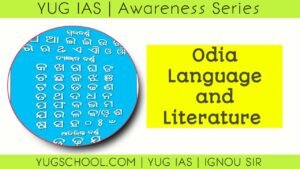
The Odia language and its vibrant literature has grown over centuries, reflecting the cultural and historical journey of Odisha. Tracing its roots back to the 8th century AD, Odia has evolved and flourished, becoming a distinct voice within the Indo-Aryan family. Let’s delve into its remarkable evolution and the development of its diverse literary landscape:
Early Stages (800 AD – 1500 AD):
Early Evidence and the Charyapadas
Histories of Odia literature often discuss the Charyapadas, Buddhist mystical songs from the early medieval period. Their language preserves features relevant to the emergence of several eastern Indo-Aryan languages.
Scholars and regional literary histories differ over the songs’ dates and linguistic classification. Readers should therefore approach them as part of a shared early linguistic setting rather than assign the entire collection exclusively to modern Odia. Official discussions of Assamese also recognize their relationship with other eastern languages. [2]
Early inscriptions, manuscripts, and religious compositions provide further evidence of regional linguistic change. By the fifteenth century, Sarala Das’s extensive writing demonstrates the expressive strength that Odia had already achieved.
Old Odia (800 AD – 1300 AD):
This formative period saw Odia emerge from Magadhi Prakrit, influenced by Sanskrit and local dialects. Early inscriptions and copper plates stand as testaments to this stage.
Early Medieval Odia (1300 AD – 1500 AD):
Odia literature blossomed with religious epics like the “Chhaupadi Mahabharata” and “Vilanka Ramayana.” Sarala Das, a revolutionary figure, composed the “Sarala Mahabharata,” marking a turning point in literary style and language development.
Golden Age (1500 AD – 1700 AD):
This era witnessed the peak of Odia literature, characterized by:
Sophistication and Refinement: The language reached its pinnacle of refinement, evident in the works of Jagannath Das (“Bhagavad Gita”) and Upendra Bhanja (“Baidehisha bilasa”).
Diverse Genres: Genres like Champu (prose-poetry), Kavya (poetry), and Chhanda (metrical verse) flourished.
Religious Influence: Vaishnavism deeply impacted literature, with works like “Laxmi Pauran” by Balaram Das and “Rasakavi” by Akhanda Rama Dasa.
Later Stages (1700 AD – 1900 AD):
Late Medieval Odia (1700 AD – 1850 AD): This period saw a decline in religious themes and a rise in social commentary. Poets like Bhima Bhoi and Fakir Mohan Senapati challenged societal norms and advocated for social reform.
Modern Odia (1870 AD onwards): The arrival of the British and the printing press brought about significant changes:
Western Influence: Western literary genres like the novel, drama, and essay gained prominence.
Social and Political Awareness: Authors like Fakir Mohan Senapati (“Chha mana atha guntha”) and Gopinath Mohanty (“Paraja”) addressed social issues and political movements.
Modernism and Experimentation: Poets like Sachi Routray and Manasi Pradhan embraced modernist styles and explored themes like identity and existentialism.
Contemporary Odia Literature:
Today, Odia literature continues to evolve, reflecting contemporary concerns and embracing new forms of expression. Key trends include:
Globalization and Identity: Writers like Arundhati Patra and Jayanta Mahapatra explore themes of cultural identity in a globalized world.
Feminist Voices: Authors like Pratibha Ray and Mamata Kumari Jena champion women’s rights and perspectives.
Regionalism and Diaspora: Writers like Manoj Das and Bibhuti Patnaik explore regional experiences and the Odia diaspora.
Development of Odia Literature:
Several key factors have contributed to the development of Odia literature:
Patronage: Royal courts, zamindars, and literary societies provided support and encouragement to writers.
Religious Influence: Religious epics, myths, and rituals served as inspiration for much of early literature.
Folk Traditions: Oral storytelling and folk songs provided a rich source of content and inspiration.
Social and Political Movements: Social movements and political struggles influenced themes and narratives.
Translations: Translations of world literature exposed Odia writers to new ideas and forms.
Educational Institutions: Universities and literary organizations played a crucial role in promoting and preserving Odia language and literature.
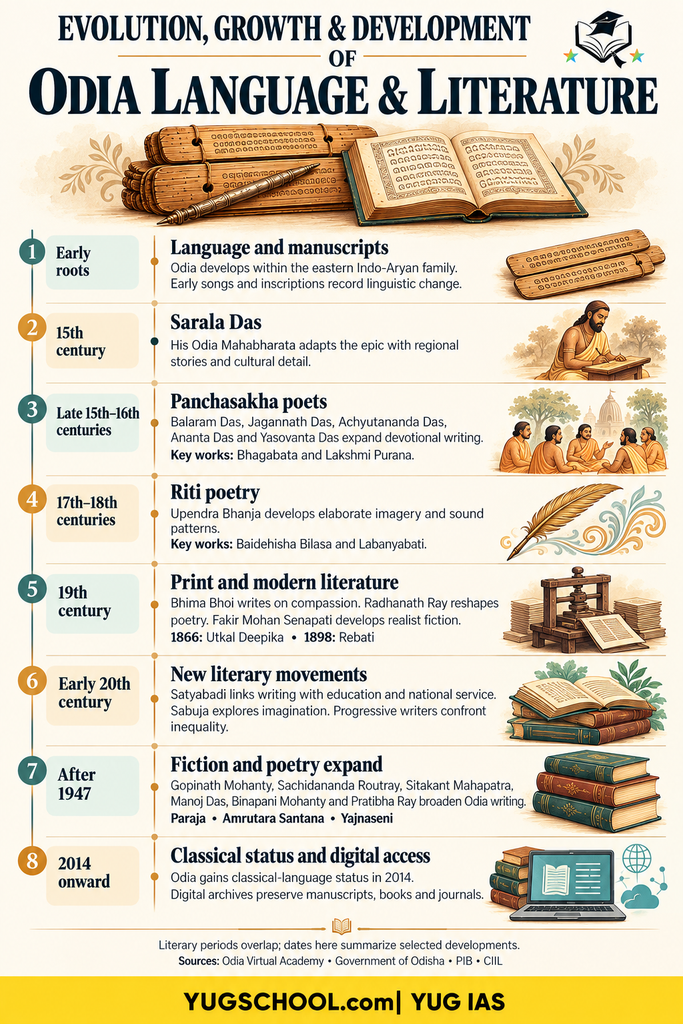
Major Periods in the History of Odia Literature
Literary historians use different period boundaries. The following outline provides an accessible guide; movements often overlap, and older forms continue alongside newer ones.
| Broad phase | Approximate period | Main developments |
|---|---|---|
| Early formation | Before the fifteenth century | Regional speech and writing develop; religious and oral traditions supply early literary material |
| Sarala phase | Fifteenth century | Sarala Das expands Odia epic narrative |
| Panchasakha phase | Late fifteenth and sixteenth centuries | Poet-saints strengthen devotional and philosophical writing |
| Riti and Bhanja traditions | Mainly seventeenth and eighteenth centuries | Poets develop elaborate diction, musical forms, and romantic narratives |
| Modern literary transition | Nineteenth and early twentieth centuries | Print, education, journalism, modern poetry, and prose fiction expand |
| Nationalist, romantic, and progressive movements | Early to mid-twentieth century | Writers explore service, freedom, individuality, and social inequality |
| Post-independence and contemporary writing | From 1947 onward | Fiction, poetry, criticism, translation, and digital publication diversify |
This outline describes literary tendencies, not a universally accepted set of linguistic dates.
Utkal Deepika and Public Debate
Gourishankar Ray launched Utkal Deepika in Cuttack on 4 August 1866, amid the devastating famine of that year.
The newspaper reported public concerns and supported the development of Odia. It also contributed to campaigns for bringing Odia-speaking areas into a separate province.
Its importance extended beyond news reporting. Journalism gave writers a space to discuss language, administration, culture, and collective interests in prose that addressed contemporary readers.
Literary periodicals also encouraged new genres. Utkal Sahitya, associated with Biswanath Kar, published poetry and fiction alongside essays on a wide range of subjects. Such journals connected authors with a recurring audience.
Radhanath Ray and Modern Odia Poetry
Radhanath Ray helped reshape Odia poetry during the late nineteenth century. His works include Chilika, Kedara Gauri, and Darabara.
He introduced new forms and adapted literary influences from beyond Odisha. Landscape, historical imagination, social criticism, and patriotic feeling gained fresh expression in his poetry.
His achievement involved both continuity and change. He worked within an established literary language while extending its themes and techniques.
Madhusudan Rao contributed to poetry and education, while Gangadhar Meher enriched the tradition through works such as Tapaswini. These writers demonstrate that modern Odia poetry developed through several creative paths.
Fakir Mohan Senapati and Modern Odia Fiction
Fakir Mohan Senapati transformed Odia prose by bringing ordinary lives and social tensions into fiction. He used humour, irony, and close observation to examine the society around him.
His characters encounter the pressures of status, education, poverty, and unequal power. This attention to lived experience helped establish a strong realist direction in Odia writing.
Rebati and the Modern Short Story
Senapati published Rebati in 1898. Literary histories widely recognize it as the first modern Odia short story available to readers.
The story follows a girl’s desire for education within a conservative village setting. Illness and family tragedy sharpen the conflict between learning, superstition, and social expectations.
The wording matters: Senapati mentioned an earlier story, Lachhamania, but researchers have not traced its text. Rebati therefore provides a firmer surviving landmark.
Chha Mana Atha Guntha
Senapati’s Chha Mana Atha Guntha, familiar in English as Six Acres and a Third, ranks among the major works of Odia fiction.
The novel examines rural society, exploitation, and the pursuit of property. Its narrative voice exposes the gap between respectable appearances and self-interest.
Alongside works such as Mamu and Prayaschitta, it shows how Odia fiction developed into a medium for sustained social criticism.
Satyabadi Literature and the Growth of National Consciousness
In the early twentieth century, the Satyabadi group connected literature with education, public service, and national awakening.
Gopabandhu Das and colleagues including Nilakantha Das, Godabarish Mishra, Krupasindhu Mishra, and Acharya Harihar helped shape this movement. Their educational work encouraged character, responsibility, and commitment to society.
The Satyabadi school began in 1909. Writing associated with this circle addressed patriotism, suffering, history, and collective duty.
The movement developed within a wider campaign for linguistic recognition and political reorganization. A separate Odisha province came into existence on 1 April 1936. Literature helped sustain the cultural consciousness surrounding that campaign.
The Satyabadi group belongs to modern history. Readers should distinguish it from the medieval Panchasakha poet-saints, even when accounts use parallel language to celebrate both groups.
Sabuja and Progressive Literary Movements
The Sabuja movement introduced a fresh romantic atmosphere in the 1920s. Writers including Kalindi Charan Panigrahi and Annada Shankar Ray explored youthful feeling, imagination, and individuality.
Their work widened the emotional range of modern literature. Collaborative literary activity also created opportunities for writers such as Sarala Devi.
Kalindi Charan’s Matira Manisha became a significant novel of rural relationships and moral conflict. His career shows why one movement label cannot explain every work an author produced.
Progressive writers subsequently placed greater emphasis on exploitation, inequality, and the circumstances of working people. Bhagabati Charan Panigrahi helped organize this literary direction in Odisha during the 1930s.
Romantic and progressive writing sometimes overlapped. Together, these movements encouraged debate about what literature should represent and whom it should address.
Post-Independence Odia Literature
After independence, Odia authors expanded the novel, short story, poetry, and literary criticism. They explored changing social relations while developing new narrative and poetic techniques.
Gopinath Mohanty brought remarkable depth to fiction about rural and Adivasi lives. Works such as Paraja and Amrutara Santana examine communities under social and economic pressure. His prose draws strength from living speech and closely observed experience.
Other major voices include Sachidananda Routray, Sitakant Mahapatra, Surendra Mohanty, and Manoj Das. Their diverse contributions helped extend Odia literature’s reach through poetry, historical fiction, short stories, and translation.
Women writers also widened its perspectives. Binapani Mohanty contributed prominently to the short story, while Pratibha Ray explored social inequality, identity, and women’s experience. Ray’s Yajnaseni revisits the Mahabharata through Draupadi’s perspective.
National recognition reflects part of this achievement:
| Writer | Jnanpith award year |
|---|---|
| Gopinath Mohanty | 1973 |
| Sachidananda Routray | 1986 |
| Sitakant Mahapatra | 1993 |
| Pratibha Ray | 2011 |
These are award years, which can differ from announcement or presentation dates.
Classical Status and the Digital Future of Odia
The Government of India granted Odia classical-language status in 2014. A parliamentary reply records 11 March 2014 as the notification date. This recognition supports attention to the language’s historical depth and literary heritage.
Preservation now extends beyond physical manuscripts. The Central Institute of Indian Languages’ Classical Odia collection brings together material relating to inscriptions, palm-leaf manuscripts, books, and journals.
The collection also highlights the breadth of knowledge in Odia. Its holdings and scope extend beyond imaginative literature to subjects such as history, medicine, astronomy, and agriculture.
Digital access can connect students and researchers with material that once required travel to specialist collections. For that access to remain useful, publishers and institutions need accurate transcriptions, reliable editions, clear metadata, and readable digital text.
Future growth also depends on everyday reading and new writing. Children’s books, translations, contemporary fiction, and accessible educational resources can help younger readers build lasting relationships with the language.
Challenges and Future Prospects:
Despite its rich legacy, Odia literature faces challenges like:
- Limited access to publishing and translation opportunities.
- Competition from dominant languages like English.
- Need for greater digital literacy and accessibility.
- Encouraging younger generations to engage with the language and literature.
Frequently Asked Questions
What is the origin of the Odia language?
Odia belongs to the eastern Indo-Aryan family. Historical accounts trace its development through eastern Prakrit and Apabhramsha traditions, with some identifying a regional stage as Odra Prakrit.
Who is the Adikabi of Odia literature?
Readers honour Sarala Das as Adikabi. His fifteenth-century Mahabharata and other works gave Odia epic literature a strong foundation.
Who were the Panchasakha poets?
The five poets were Balaram Das, Jagannath Das, Achyutananda Das, Ananta Das, and Yasovanta Das. They made major contributions to devotional and philosophical writing.
Why is Fakir Mohan Senapati important?
Senapati helped establish modern Odia fiction through social observation, humour, and realism. His major works include Rebati and Chha Mana Atha Guntha.
When did Odia receive classical-language status?
Odia received classical-language status in 2014. The government records 11 March 2014 as the notification date.
The history of Odia language and literature shows a tradition that keeps finding new forms. Epic poets, devotional singers, journalists, novelists, and digital archivists have each extended its possibilities. Reading across these periods reveals how the language preserves inherited knowledge while giving new generations room to speak.
Sources and Further Reading
- President of India — Granth Kutir overview, Odia section
- Press Information Bureau — Assamese and shared eastern linguistic heritage
- Unicode — South and Central Asia, Oriya/Odia section
- Government of Odisha — Literature
- Odia Virtual Academy — Sarala Das
- Odisha Review — Classical Status to Odia Language
- Odia Virtual Academy — Jagannath Das
- Odisha Review June 2009 — Bhagabata and recitation traditions
- Odia Virtual Academy — Upendra Bhanja
- Odia Virtual Academy — Bhima Bhoi
- Odia Virtual Academy — Radhanath Ray
- Ministry of Culture — Utkal Dipika
- Odia Virtual Academy — Biswanath Kar and Utkal Sahitya
- Odisha Review — Great Heritage of Orissa
- Government of Odisha — Fakir Mohan Senapati
- Odisha Review September 2010 — Fakir Mohan and Rebati
- Odisha Review April 2022 — Fakir Mohan Senapati
- Odisha Review September–October 2014 — Satyabadi education and literature
- Odisha Review April 2023 — Formation of Odisha province
- Odisha Review August 2012 — Sarala Devi and the Sabuja group
- Odisha Review August–September 2013 — Kalindi Charan Panigrahi
- International Journal of Linguistics, Literature and Culture — Progressive Movement in Odia Literature
- Odia Virtual Academy — Gopinath Mohanty
- Odisha Reference Annual — Literary figures including Binapani Mohanty
- Odia Virtual Academy — Pratibha Ray
- Bharatiya Jnanpith — Laureates and Pratibha Ray profile
- Press Information Bureau — Classical-language notification dates
- CIIL Bhasha Sanchika — Classical Odia collection