


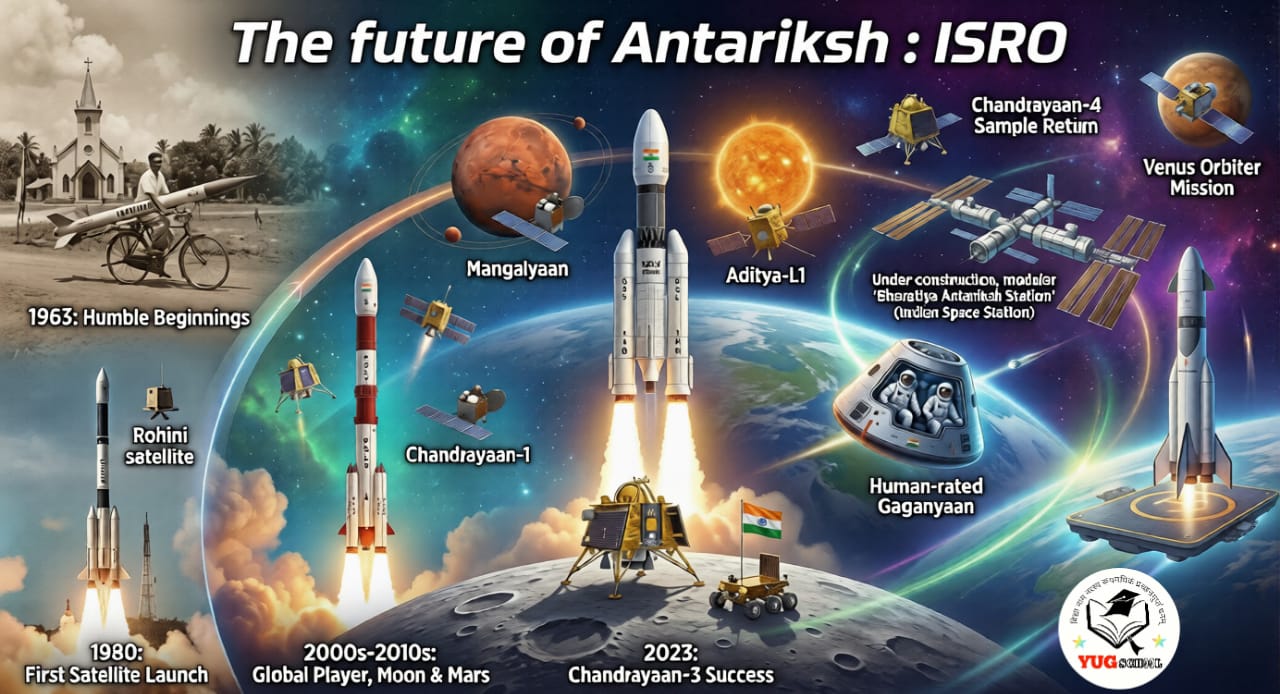
The evolution of the Indian Space Research Organisation (ISRO) constitutes a unique paradigm in the global history of aerospace development. Unlike the space programs of the United States and the Soviet Union, which were born in the crucible of Cold War ballistic missile rivalry, India’s space program was conceived with a distinct developmental mandate: to utilize advanced technology for the socio-economic upliftment of a newly independent nation. From its nascent stages transporting sounding rockets on bicycles to its current status as a comprehensive space power capable of interplanetary exploration and heavy-lift launches, ISRO’s trajectory offers a masterclass in technological indigenization, strategic resilience, and frugal engineering.
We will provide an exhaustive analysis of ISRO’s fifty-year journey. In next few minutes, We will be dissecting the organization’s transition from an experimental scientific body to a strategic asset central to India’s national security and geopolitical aspirations. The analysis identifies three core pillars of ISRO’s evolution:
-
Technological Sovereignty through Indigenization: The systematic mastery of the complete space fuel cycle—solid, liquid, and cryogenic propulsion—despite punitive international technology denial regimes such as the Missile Technology Control Regime (MTCR). This culminated in the operationalization of the Cryogenic Upper Stage (CUS) and the Launch Vehicle Mark-3 (LVM3), ending India’s reliance on foreign launch providers for critical heavy satellites.
-
Frugal Engineering and Economic Efficiency: ISRO has institutionalized a cost-effective operational model characterized by the “Proto-Flight” philosophy, modular satellite bus architectures, and an indigenous supply chain. This approach allowed the agency to execute the Mars Orbiter Mission (Mangalyaan) for approximately $74 million—a fraction of global benchmarks—while generating a domestic economic multiplier effect of 2.54 times for every unit of currency invested.
-
Strategic Autonomy and Civil-Military Fusion: The shift from a purely civilian posture to a dual-use capability framework, driven by regional security dynamics. The deployment of the NavIC regional navigation system to bypass GPS dependency, coupled with dedicated defense satellites like GSAT-7 (Navy) and GSAT-7A (Air Force), underscores space as a critical domain for India’s defense architecture.
Furthermore, the report examines the contemporary paradigm shift within the Indian space ecosystem, catalyzed by the 2020 reforms. The establishment of the Indian National Space Promotion and Authorisation Centre (IN-SPACe) and NewSpace India Limited (NSIL) has opened the sector to private enterprise, fostering a vibrant startup ecosystem including entities like Skyroot Aerospace, Agnikul Cosmos, and Pixxel. As India prepares for human spaceflight (Gaganyaan) and targets the deployment of the Bharatiya Antariksh Station (BAS) by 2035, ISRO is recalibrating its role from a monopoly operator to an enabler of a national space economy, balancing cooperative diplomacy via the Artemis Accords with the imperative of maintaining independent strategic access to the cosmos.
Genesis and Ideological Foundations: The Sarabhai Paradigm (1962–1980)
1. The Vision of Leapfrogging
The foundational philosophy of the Indian space program was articulated by Dr. Vikram Sarabhai, a visionary scientist who viewed space technology not as a vehicle for national prestige or power projection, but as a pragmatic tool for development. In the early 1960s, while the superpowers were engaged in a race for lunar dominance driven by ideological supremacy, Sarabhai convinced the Indian government that a developing nation could not afford to follow the sequential industrialization path of the West. Instead, he proposed “leapfrogging” traditional developmental hurdles using satellite technology for mass communication, meteorology, and education.
This vision led to the establishment of the Indian National Committee for Space Research (INCOSPAR) in 1962 under the Department of Atomic Energy, spearheaded by Sarabhai with the support of Dr. Homi Bhabha. The establishment of the Thumba Equatorial Rocket Launching Station (TERLS) in Kerala marked the beginning of India’s experimental phase. Thumba was selected for its proximity to the magnetic equator, making it ideal for atmospheric research, a decision that underscored the scientific rather than military focus of the early program.
2. Institutionalization and Early Struggles
The formal constitution of the Indian Space Research Organisation (ISRO) on August 15, 1969, superseded INCOSPAR, institutionalizing space research under a dedicated body. This was further solidified in 1972 with the creation of the Space Commission and the Department of Space (DOS), bringing ISRO directly under the purview of the Prime Minister—a structure that ensured high-level political support and bureaucratic autonomy.
The 1970s were defined by a “learning by doing” approach. ISRO’s strategy was to utilize foreign satellites and launch vehicles to gain operational experience while simultaneously developing indigenous capabilities. The Satellite Instructional Television Experiment (SITE) in 1975-76, conducted in partnership with NASA, remains one of the largest sociological experiments in the world, using the ATS-6 satellite to beam educational programs to 2,400 remote Indian villages. This validated Sarabhai’s thesis that space assets could deliver direct socio-economic benefits to the grassroots level.
However, the path to indigenous launch capability was fraught with failure. The initial development of the Satellite Launch Vehicle-3 (SLV-3) faced significant technical hurdles. It was only in 1980 that the SLV-3, under the directorship of Dr. A.P.J. Abdul Kalam, successfully placed the Rohini satellite into orbit, making India the sixth country to achieve spacefaring capability. This success was pivotal, transitioning ISRO from an agency that used space data to one that could access space independently.
The Launch Vehicle Odyssey: Evolution of Indigenous Capability
The development of ISRO’s launch vehicle fleet represents a narrative of incremental scaling, where each generation of vehicle addressed specific payload requirements and technological gaps, often in the face of international sanctions.
1. The Solid Propulsion Foundation: SLV and ASLV
ISRO began its propulsion journey with solid fuels, which are chemically stable and easier to store but offer lower specific impulse (efficiency) compared to liquid fuels. The SLV-3 was an all-solid, four-stage vehicle capable of lifting 40 kg to Low Earth Orbit (LEO).While modest in capability, it allowed ISRO to master solid propellant casting, stage separation, and trajectory control.
The Augmented Satellite Launch Vehicle (ASLV) was designed as a bridge to the operational class vehicles. Capable of lifting 150 kg to LEO, the ASLV featured a five-stage all-solid configuration (including strap-ons). The program suffered consecutive failures in its early flights (1987, 1988) due to issues with ignition and control dynamics. However, these failures were instrumental in validating the strap-on booster technology and closed-loop guidance systems that would later become the backbone of the PSLV.
2. The Workhorse: Polar Satellite Launch Vehicle (PSLV)
The commissioning of the Polar Satellite Launch Vehicle (PSLV) in 1994 marked the maturation of ISRO into a global launch service provider. The PSLV represented a significant technological leap, introducing liquid propulsion stages for the first time in an Indian vehicle. It employs a unique four-stage configuration alternating between solid and liquid stages (Solid-Liquid-Solid-Liquid).
The integration of the Vikas engine (based on the French Viking engine) in the second stage provided the thrust control and efficiency required for complex orbital maneuvers. The PSLV’s modularity allows it to fly in different configurations—Core Alone (CA), Standard, and XL (with extended strap-on motors)—depending on the payload mass.
Operational Significance of PSLV:
-
Mission Versatility: The PSLV is capable of launching satellites into Sun-Synchronous Polar Orbits (SSPO) for remote sensing and Geostationary Transfer Orbits (GTO) for light communication satellites.
-
Global Reliability: With over 50 successful missions, it has earned the moniker of ISRO’s “workhorse.” It was the vehicle of choice for India’s marquee scientific missions, including Chandrayaan-1 (Moon) and Mangalyaan (Mars).
-
Commercial Success: The PSLV’s reliability and cost-competitiveness enabled ISRO to capture a share of the global small-satellite launch market. A historic milestone was achieved in February 2017 (PSLV-C37), when a single PSLV launched 104 satellites, demonstrating complex mission planning and multiple-orbit injection capabilities.
3. The Cryogenic Challenge: GSLV and the Technology Denial Regime
To achieve true strategic autonomy, ISRO needed the capability to launch heavy communication satellites (2-ton class) into GTO. This required the Geosynchronous Satellite Launch Vehicle (GSLV) and, crucially, Cryogenic Upper Stage (CUS) technology. Cryogenic engines use liquid hydrogen (LH2) and liquid oxygen (LOX) stored at extremely low temperatures (-253°C and -183°C respectively). They offer a higher specific impulse than earth-storable liquid fuels, making them essential for heavy-lift missions.
The Geopolitical Pivot (1992): In the early 1990s, ISRO signed an agreement with the Russian agency Glavkosmos to transfer cryogenic engine technology. However, the United States invoked the Missile Technology Control Regime (MTCR) in 1992 to block the deal, arguing that the technology could be used for ballistic missiles—a claim contested by experts since cryogenic fuels are difficult to store and unsuitable for rapid-response weapons. Under US pressure, Russia cancelled the technology transfer but agreed to supply seven ready-made KVD-1 engines.
This denial forced ISRO to embark on the indigenous development of the Cryogenic Upper Stage (CUS). The development was technically arduous, involving the mastery of complex metallurgy, rotary seals for turbopumps operating at high speeds, and thermal insulation. After nearly two decades of development and initial failures (notably the GSLV-D3 in 2010), ISRO successfully qualified the indigenous CE-7.5 cryogenic engine in 2014. This marked a definitive victory for technological sovereignty, ending India’s dependence on foreign launch vehicles for the INSAT/GSAT class satellites.
4. LVM3: The Heavy Lift Capability
The Launch Vehicle Mark-3 (LVM3), formerly known as GSLV Mk III, represents the current pinnacle of ISRO’s launch capability. It is designed to place 4-ton class satellites into GTO and 10 tons into LEO, making it a medium-heavy lift vehicle by global standards.
Technical Architecture of LVM3:
-
S200 Solid Boosters: Two massive solid strap-on boosters, among the largest in the world, provide the initial thrust for lift-off.
-
L110 Core Stage: A liquid core stage powered by two clustered Vikas engines initiates operation after the solid boosters.
-
C25 Cryogenic Upper Stage: Powered by the indigenously developed CE-20 engine, which is a high-thrust cryogenic engine using a gas-generator cycle. This engine is significantly more powerful than the CE-7.5 used in the GSLV Mk II.
The LVM3 has maintained a flawless success record since its development flights. It has been designated as the launch vehicle for the Gaganyaan human spaceflight mission, necessitating a rigorous “human-rating” process. This involves structural strengthening, the addition of a Crew Escape System (CES), and the implementation of higher redundancy in avionics and control systems to ensure crew safety.
The Economics of Indian Spaceflight: Anatomy of Frugal Engineering
ISRO is globally celebrated for its cost-effectiveness, a trait that has become a competitive advantage in the commercial launch market. The most cited example is the Mars Orbiter Mission (Mangalyaan), which cost approximately $74 million. In comparison, NASA’s MAVEN mission to Mars cost roughly $671 million, and the production budget of the Hollywood film Gravity was $100 million. This disparity is not merely a function of lower labor costs in India (arbitrage) but the result of a deliberate engineering and managerial philosophy known as “Frugal Engineering.”
1. Structural Drivers of Cost Efficiency
The economic efficiency of ISRO is driven by several structural factors:
-
Structural Factor
-
Description
-
Cost Implication
-
Proto-Flight Philosophy
Western agencies typically build a Qualification Model (QM) for ground testing and a separate Flight Model (FM) for the mission. ISRO often employs a “Proto-Flight” approach where the flight hardware itself is subjected to qualification-level testing (with careful margin management) and then launched. It drastically reduces hardware manufacturing costs and schedules by eliminating the need for a dedicated non-flying test article for every mission.
Modular Bus Architecture
ISRO has standardized its satellite platforms (I-1K, I-2K, I-3K). A common bus structure is used for multiple missions (e.g., I-1K for meteorology and remote sensing), requiring only the payload to be changed and reduces Non-Recurring Engineering (NRE) costs and leverages economies of scale in component procurement.
Indigenous Supply Chain
Heavy reliance on domestic industry and in-house development for critical components prevents capital flight to expensive foreign aerospace vendors.It also Insulates the program from currency fluctuations and the high profit markups of Western defense contractors.
Risk-Optimized COTS
Strategic use of Commercial Off-The-Shelf (COTS) components for non-critical systems, screened via rigorous in-house testing, rather than using exclusively Mil-Spec or Space-Grade components which are exponentially more expensive. It also Lowers the bill of materials (BOM) without compromising mission success probability for specific risk profiles.
2. The Economic Multiplier Effect
The investment in ISRO generates substantial downstream economic benefits. A socio-economic impact analysis commissioned by ISRO and conducted by Novaspace and EconOne revealed a significant Return on Investment (ROI). For every rupee invested in the Indian space program, the economy receives approximately ₹2.54 in return through direct, indirect, and induced benefits.
This multiplier effect manifests in various sectors:
-
Agriculture: Satellite-aided crop monitoring and soil health analysis contribute to precision farming, reducing input costs for farmers.
-
Fisheries: Potential Fishing Zone (PFZ) advisories based on ocean color and thermal data help fishermen reduce fuel consumption and search time, increasing catch per unit effort.
-
Disaster Mitigation: Accurate cyclone warnings significantly reduce economic loss and loss of life, preserving human capital.
3. Case Study: Chandrayaan-3 vs. Chandrayaan-2
The cost-effectiveness of ISRO is also evident in its failure recovery analysis. Following the crash of the Chandrayaan-2 lander in 2019, ISRO did not commission a blank-sheet redesign for the follow-up mission. Instead, for Chandrayaan-3 ($75 million), engineers retained the existing orbiter from the previous mission (which was still functional) and focused resources solely on the lander and propulsion module.
Technological improvements were targeted and specific:
-
Leg Strengthening: The lander legs were reinforced to withstand higher impact velocities.
-
Fuel Capacity: Increased propellant was added to handle greater dispersion and allow for more flexible landing site selection.
-
Sensor Redundancy: New sensors, such as the Laser Doppler Velocimeter (LDV), were added to provide precise velocity data during descent.
-
Software Logic: The guidance software was updated to a “failure-based design,” creating larger margins for error correction during the autonomous landing phase.
This approach of incremental, data-driven modification rather than complete system overhaul is a hallmark of ISRO’s frugal engineering culture.
Strategic Autonomy and National Security: The Dual-Use Imperative
While ISRO has traditionally maintained a civilian posture, the changing geopolitical landscape of the Indo-Pacific and the militarization of space by neighbors like China have necessitated a shift toward “dual-use” capabilities. Space assets are now integral to India’s national security architecture, providing Command, Control, Communications, Computer, Intelligence, Surveillance, and Reconnaissance (C4ISR) capabilities.
1. NavIC: The Imperative of Independent Navigation
The Kargil War of 1999 served as a strategic inflection point for India’s space policy. During the conflict, the Indian military requested high-precision GPS data from the United States to target enemy positions in the high-altitude terrain. The US denied this request, degrading India’s operational effectiveness. This incident underscored the vulnerability of relying on foreign-controlled Global Navigation Satellite Systems (GNSS) during hostilities.
In response, ISRO developed the Indian Regional Navigation Satellite System (IRNSS), operationally known as NavIC (Navigation with Indian Constellation). Unlike GPS or Galileo, which are global systems, NavIC is a regional constellation comprising seven satellites (three in geostationary orbit, four in geosynchronous orbit). It covers the Indian landmass and a region extending 1,500 km beyond its borders.
Strategic Advantages of NavIC:
-
Guaranteed Access: It provides two services: the Standard Positioning Service (SPS) for civilians and the Restricted Service (RS) for authorized users (military). The RS is encrypted, ensuring that the Indian armed forces have access to precise Position, Navigation, and Timing (PNT) data that cannot be spoofed or denied by foreign powers.
-
Regional Accuracy: By focusing on a specific region, NavIC uses dual-frequency bands (S-band and L-band) to provide superior accuracy in the ionosphere-heavy tropical region compared to single-band GPS, aiding in precision missile targeting and troop navigation.
2. Dedicated Military Assets: The “Eye in the Sky”
To support Network-Centric Warfare (NCW), ISRO has deployed a series of dedicated satellites that serve specific branches of the armed forces, managed under the Defence Space Agency (DSA).
-
GSAT-7 (Rukmini): Launched in 2013, this is the Indian Navy’s dedicated communication satellite. It provides real-time networking capabilities to warships, submarines, and maritime aircraft across the vast Indian Ocean Region (IOR), enabling the Navy to operate as a cohesive blue-water force.
-
GSAT-7A (Angry Bird): Launched in 2018 for the Indian Air Force (IAF), this satellite links ground radar stations, airbases, and Airborne Warning and Control System (AWACS) aircraft. It also extends the operational range of Unmanned Aerial Vehicles (UAVs) by transitioning them from line-of-sight control to satellite control.
-
RISAT Series: The Radar Imaging Satellites (RISAT) are equipped with Synthetic Aperture Radar (SAR), which can image the earth through cloud cover and darkness. These satellites (RISAT-2, RISAT-2B) were critical in providing surveillance data for the 2016 surgical strikes and the 2019 Balakot airstrikes, where optical satellites would have been blinded by weather or night.
-
EMISAT: Launched in 2019, EMISAT carries an Electronic Intelligence (ELINT) package (Project Kautilya) designed to detect and locate enemy radar signatures. This capability is vital for mapping enemy air defense networks and planning Suppression of Enemy Air Defenses (SEAD) missions.
3. Space Situational Awareness (SSA)
The militarization of space has also led to the development of Space Situational Awareness capabilities. The NETRA (Network for Space Object Tracking and Analysis) project involves a network of radars and optical telescopes to track space debris and active satellites. This is crucial for protecting Indian space assets from collisions and potential “killer satellites” or co-orbital threats from adversaries, ensuring the resilience of India’s space infrastructure.
Socio-Economic Impact: Space for the Common Man
ISRO’s alignment with national development goals remains its most distinguishing feature. The agency has systematically integrated space technology into the administrative and disaster management framework of the country.
1. Disaster Management: The Cyclone Shield
The Bay of Bengal is one of the most cyclone-prone regions in the world. In 1999, the Odisha Super Cyclone resulted in nearly 10,000 deaths due to a lack of timely warning and evacuation. In stark contrast, during Cyclone Phailin (2013) and Cyclone Fani (2019), the death tolls were reduced to double digits (less than 50 for Fani), despite the storms being of comparable intensity.
This dramatic reduction in mortality is directly attributed to ISRO’s meteorological satellites (INSAT-3D, OceanSat), which provided precise data on cyclone trajectory, intensity, and landfall time. This data enabled the Indian Meteorological Department (IMD) and local authorities to execute the targeted evacuation of over a million people. Global institutions, including the World Bank, have cited India’s satellite-based cyclone warning system as a model for disaster risk reduction.
2. Agriculture and Food Security
Remote sensing data is deeply embedded in India’s agricultural economy through the FASAL (Forecasting Agricultural output using Space, Agrometeorology and Land based observations) program.
-
Yield Estimation: Satellite data is used to estimate crop acreage and production before harvest, allowing the government to plan food grain procurement, storage, and pricing policies.
-
Precision Agriculture: Projects involve using satellite data to determine soil moisture levels and crop health, enabling the dissemination of advisories to farmers regarding irrigation scheduling and fertilizer application. This increases resource efficiency and resilience against climate variability.
-
Crop Insurance: Satellite imagery provides objective data for assessing crop damage following natural calamities, facilitating faster and more transparent insurance claim settlements for farmers under the Pradhan Mantri Fasal Bima Yojana.
3. Tele-Education: The EDUSAT Legacy
Launched in 2004, EDUSAT (GSAT-3) was the world’s first satellite dedicated exclusively to the education sector. It was designed to bridge the digital divide by connecting remote rural classrooms with expert teachers in urban centers via two-way audio-video communication. Impact assessments have shown that tele-education networks have improved student learning outcomes and provided essential training for rural teachers who otherwise lack access to professional development resources.
Geopolitics and Space Diplomacy
Space has emerged as a sophisticated instrument of India’s foreign policy, deployed to foster regional integration and counter the influence of rival powers in the South Asian neighborhood.
1. The South Asia Satellite (GSAT-9)
In 2014, Prime Minister Narendra Modi proposed a “satellite for SAARC” as a gift to India’s neighbors, reflecting the “Neighborhood First” foreign policy. Launched in 2017, the South Asia Satellite (GSAT-9) provides communication, disaster management, and telemedicine services to Afghanistan, Bangladesh, Bhutan, the Maldives, Nepal, and Sri Lanka.
Geopolitical Significance:
The satellite services are provided free of cost to the partner nations. This initiative serves as a strategic counterweight to China’s Belt and Road Space Information Corridor, which seeks to integrate South and Southeast Asian nations into a Chinese-led space infrastructure. By providing a public good, India reinforces its position as a benevolent regional power and prevents the complete dependency of smaller neighbors on Chinese satellite data and connectivity.66 Pakistan was the only SAARC nation to opt out, citing security concerns, a move that further isolated it from regional integration efforts.
2. The Artemis Accords and Strategic Hedging
In June 2023, India signed the Artemis Accords, joining the US-led international coalition for civil space exploration and the return of humans to the Moon. This decision marks a significant pivot in India’s space diplomacy, which had historically maintained a non-aligned or Russia-leaning stance.
Strategic Rationale:
-
Technology Access: Joining the Accords opens avenues for Indian companies and ISRO to participate in NASA’s supply chains and access advanced technologies for lunar exploration.
-
Balancing Act: Despite signing the US-led accords, India continues its deep cooperation with Russia (Roscosmos) for the Gaganyaan mission, specifically for astronaut training and the supply of critical life support components. This “strategic hedging” allows India to leverage Western technology for future exploration while maintaining trusted partnerships for immediate critical programs.
The New Space Paradigm: Privatization and Reform
Recognizing that ISRO alone cannot scale to capture a significant share of the $400 billion global space economy, the Government of India initiated sweeping reforms in 2020 to open the sector to Non-Government Entities (NGEs).
1. Institutional Enablers: IN-SPACe and NSIL
Two new bodies were established to facilitate this transition:
-
IN-SPACe (Indian National Space Promotion and Authorisation Centre): Acting as an autonomous regulator and facilitator, IN-SPACe authorizes private space activities and creates a mechanism for private companies to utilize ISRO’s infrastructure (launch pads, testing facilities). It creates a “level playing field,” transforming ISRO from a monopoly competitor into a mentor for the private sector.
-
NSIL (NewSpace India Limited): A Public Sector Undertaking (PSU) serving as the commercial arm of the Department of Space. Unlike its predecessor Antrix, NSIL has a mandate to be “demand-driven,” owning and operating satellites and transferring ISRO’s mature technologies (like the PSLV) to industry consortiums for production.
2. The Rise of the Indian Space Startup Ecosystem
These reforms have catalyzed an explosion of innovation in the private sector:
-
Skyroot Aerospace: In November 2022, Skyroot launched Vikram-S, India’s first privately developed rocket. The company is developing the Vikram series of orbital launch vehicles, featuring 3D-printed engines and carbon composite structures, aiming to provide on-demand launch services for small satellites.
-
Agnikul Cosmos: This startup successfully flight-tested the Agnibaan SOrTeD demonstrator in 2024. The vehicle is powered by the Agnilet engine, the world’s first single-piece 3D-printed semi-cryogenic engine. This manufacturing innovation allows for rapid production (an engine can be printed in days) and eliminates thousands of assembly points, increasing reliability.
-
Pixxel: Focused on downstream applications, Pixxel is deploying a constellation of hyperspectral imaging satellites. Unlike standard optical cameras, hyperspectral sensors capture data across hundreds of narrow bands, allowing for the detection of invisible phenomena such as crop diseases, gas leaks, and soil nutrient levels. Pixxel has already launched satellites with ISRO and SpaceX and secured contracts with major global defense and intelligence agencies.
Future Roadmap: Human Spaceflight and Beyond
1. Gaganyaan: The Human Spaceflight Mission
The Gaganyaan mission aims to demonstrate India’s capability to send a three-member crew to an orbit of 400 km for a 3-day mission and bring them back safely. This mission represents the most complex engineering challenge ISRO has ever undertaken.
Key Technology Challenges:
-
Environmental Control and Life Support System (ECLSS): This system is required to maintain earth-like conditions (oxygen, temperature, pressure) inside the crew module. After international partners were unwilling to share this sensitive technology, ISRO decided to develop the ECLSS indigenously, reinforcing the theme of innovation driven by denial.
-
Crew Escape System (CES): A critical safety feature designed to pull the crew module away from the rocket in case of a launch abort. ISRO has successfully conducted pad abort tests and in-flight abort demonstrations (TV-D1) to validate this system.
2. Bharatiya Antariksh Station (BAS) and Lunar Landing
ISRO has outlined an ambitious roadmap for the next two decades, aiming to establish a permanent Indian presence in space:
-
2028: Launch of the first module of the Bharatiya Antariksh Station (BAS), an indigenous space station.
-
2035: Full operationalization of the BAS, which will serve as a laboratory for microgravity research.
-
2040: Targeted date for landing an Indian astronaut on the Moon.
To support these ambitions, ISRO is developing the Next Generation Launch Vehicle (NGLV), which will utilize semi-cryogenic propulsion (refined kerosene and LOX) and feature reusable stages to drastically reduce launch costs. The development of the high-thrust SCE-200 semi-cryogenic engine is pivotal to this future architecture.
The Ascent of Antariksh: A Comprehensive Strategic Analysis of the Indian Space Research Organisation (ISRO)
Conclusion
The evolution of ISRO from the quiet fishing hamlet of Thumba to the forefront of global space exploration is a testament to the resilience and ingenuity of the Indian scientific community. ISRO has successfully navigated a complex landscape of geopolitical constraints, turning technology denial regimes into catalysts for indigenization.
The organization has adhered to a unique developmental model where high technology is strictly aligned with socio-economic utility—saving lives during cyclones, improving agricultural yields, and connecting the unconnected. Simultaneously, it has quietly but effectively secured India’s strategic autonomy through the deployment of independent navigation and surveillance assets.
As the Indian space ecosystem undergoes a paradigm shift with the entry of private players and ambitious goals for human spaceflight, ISRO is transitioning from a solitary operator to the anchor of a burgeoning national space economy. With a proven track record of frugal engineering and a clear roadmap for the future, India is poised to not just participate in the second space age but to define it, balancing the aspirations of a rising power with the needs of its people.